
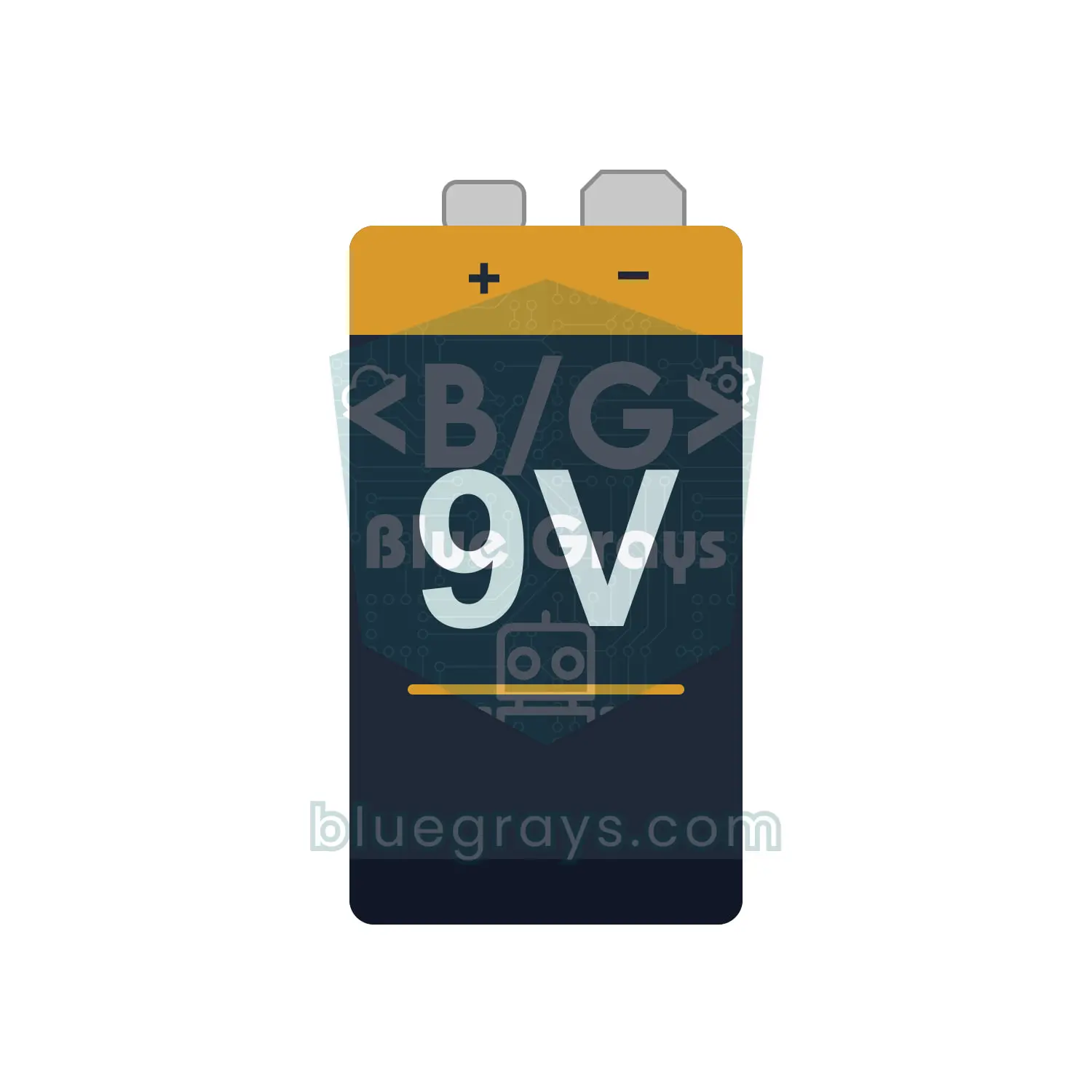
The 9V battery is a rectangular battery with two snap terminals side by side on its top; it is also sold as 6F22 or 6LR61. Because it is small and light, it is a practical supply for circuits built on a breadboard without a microcontroller, such as 555 flashers, transistor circuits and 4000-series ICs. An alkaline one holds about 500 mAh, so it suits loads that draw little current, like LEDs and ICs; it cannot power parts that need high current, such as motors or servos. The small round terminal is positive and the larger hexagonal one is negative. It connects to the circuit through a battery clip. 74HC-series ICs tolerate at most 6 V, so do not power them straight from a 9V battery; put a 5 V regulator in between. The battery counts as empty once its voltage falls below 7 V.