
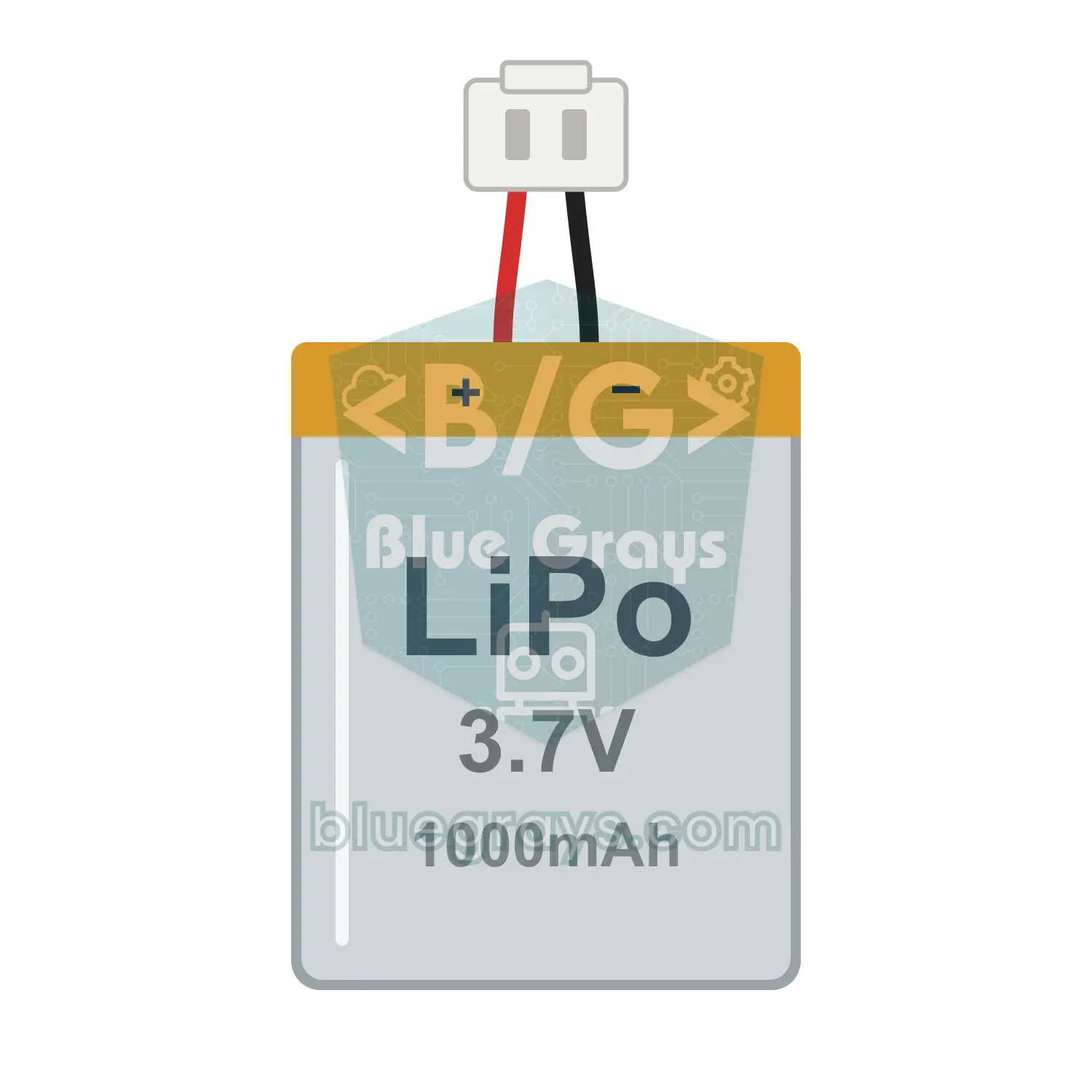
A single-cell LiPo (lithium polymer) battery is a thin, lightweight rechargeable battery with a soft pouch body. Its nominal voltage is 3.7 V; it reads 4.2 V when fully charged and about 3.0 V when empty. Its capacity ranges from 100 mAh to several thousand mAh, depending on size. Most of the ones sold for hobby use have a protection circuit under the yellow tape and a JST connector on the lead; the plus and minus order on the connector can differ between sellers, so check it with a multimeter before plugging in. You charge it with a lithium charging circuit that stops at 4.2 V, such as the TP4056; for most batteries the charge current should not exceed one times the capacity (1C), which means at most 0.5 A for a 500 mAh battery. TP4056 modules usually come set to 1 A, so with small batteries you need to change the charge-current programming resistor. Do not connect it directly to the 3.3 V pin of boards like the ESP32 and Pico; connect it through the board's battery or power input (for example VSYS on the Pico) or through a regulator. Puncturing, bending and short circuits can cause a fire; do not use or charge a swollen battery. It is a good fit for wearable projects, portable sensors and small robots.