
Teroka Projek Arduino
Ratusan projek dari pemula hingga mahir: gambar rajah litar, kod dan video. Mulakan di tahap mana pun kamu berada.

ESP32 LED Brightness Control with a Potentiometer (Analog → PWM)
In this project, we control the brightness of an LED analogically using a potentiometer. The ESP32's ADC pin reads the 0-3.3V voltage from the potentiometer, and this value is then converted into a PWM (Pulse Width Modulation) signal and sent to the LED. As a result, as you turn the potentiometer, the LED gradually brightens and dims. With Arduino Core 3.0+, analogWrite() can be used directly; on the ESP32-S2/S3, the ADC resolution is fixed at 12-bit.

ESP32 Servo Motor (Potentiometer Control)
In this project, we control an SG90 servo motor using a potentiometer. We adjust the servo angle by mapping the analog value read from the potentiometer to the 0–180-degree range. The ESP32Servo library generates servo signals on suitable output-capable GPIO pins of the ESP32; this project uses GPIO 18. This is a fundamental control method for robotic arms, camera gimbals, and automatic door mechanisms.

ESP32 I2C LCD Display (16x2)
In this project we connect a 16x2 character LCD to the ESP32 over I2C and display text. With I2C, just 2 data pins (SDA and SCL) control the screen, instead of the 6+ pins a classic parallel connection wastes. The code prints a fixed message on the first line and a counter that goes up every second on the second. At startup an I2C scanner also prints the display's address to the Serial Monitor (usually 0x27 or 0x3F).

Digital Clock with ESP32 and DS1307 RTC (I2C + LCD)
In this project, we display the time and date on a 16x2 I2C LCD screen using the DS1307 real-time clock (RTC) module. The DS1307 is a battery-backed RTC that maintains the time even if the ESP32 is powered off. Both modules share the same I2C bus (SDA/SCL), allowing us to learn how to control multiple devices using just two signal wires. Through this project, you will gain practical knowledge of the I2C communication protocol, RTC module operation, and dynamic data display on an LCD screen.

Automatic Lighting with the ESP32 PIR Motion Sensor
In this project an HC-SR501 PIR motion sensor detects someone entering the room and turns on an LED automatically. millis() tracks how long the LED stays on: each HIGH reading refreshes the last-motion time, and the LED turns off at least 10 seconds after the last HIGH. The code also waits 50 ms with delay(50) in every loop, so the loop is not fully non-blocking. Great for stairs, hallways, bathrooms or closet lighting.

Remote Control with ESP32 IR Receiver (with LCD Screen)
In this project, we use the TSOP4838 IR receiver module to capture signals from a TV, air conditioner, or any other infrared remote control using the ESP32. With the IRremote v4 library, we display decoded nonzero raw codes on the I2C LCD screen. This example is intended to help identify remote control codes; it does not include turning an LED on or off or adjusting its brightness with the remote. This is a great starting point for converting old remotes into smart home controls.

ESP32 TM1637 4-Digit 7-Segment Display
We are controlling a 4-digit 7-segment display module with a TM1637 driver using an ESP32. Using just 2 GPIO pins (CLK and DIO), we run a counter from 0 to 9999, adjust the brightness level, and display the colon (:) character in clock format. Thanks to the TM1637Display library, controlling numbers, hex values, segments, and strings is very easy.

ESP32 WS2812B NeoPixel Strip Control
WS2812B (NeoPixel) addressable LEDs are smart RGB LEDs that can be chained and controlled from a single data pin. In this project we drive an 8-LED WS2812B strip with the Adafruit_NeoPixel library and create a smooth rainbow animation. The ESP32's 3.3V logic works with most WS2812B batches; if it gets unstable, we show the fix with a 470Ω series resistor and a 1000µF capacitor. The animation shifts the hue in HSV color space.
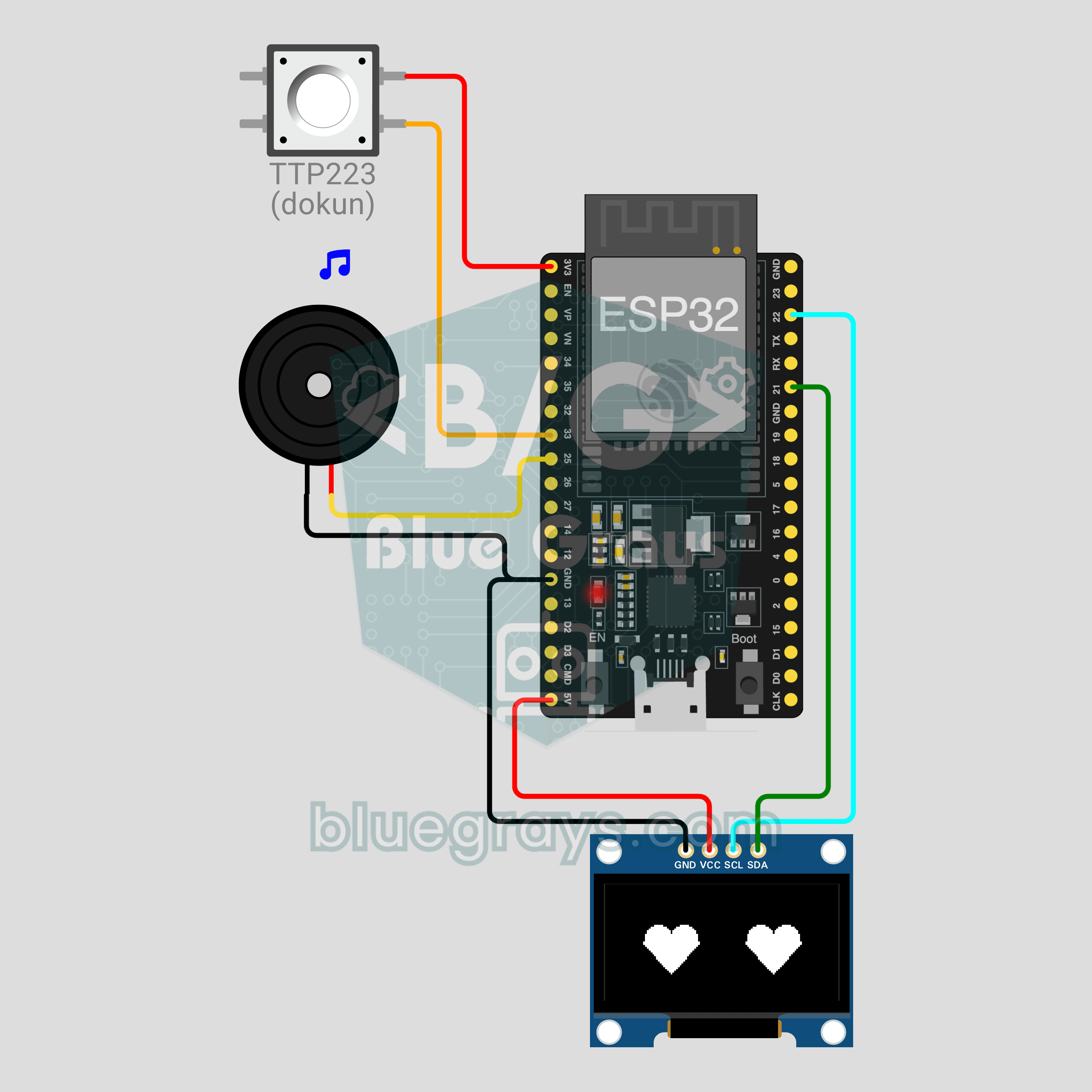
ESP32 Robot Eyes (OLED Display + TTP223 Touch Sensor)
A desk robot with feelings! The ESP32 draws two eyes on a 0.96 inch OLED that look around and blink on their own. Tap the TTP223 touch sensor and the robot gets happy, hold it and the eyes turn into hearts, poke it too often and it gets angry, ignore it for 20 seconds and it falls asleep. A passive buzzer gives every mood its own sound: a state machine, shape-based animation and non-blocking audio in one project.
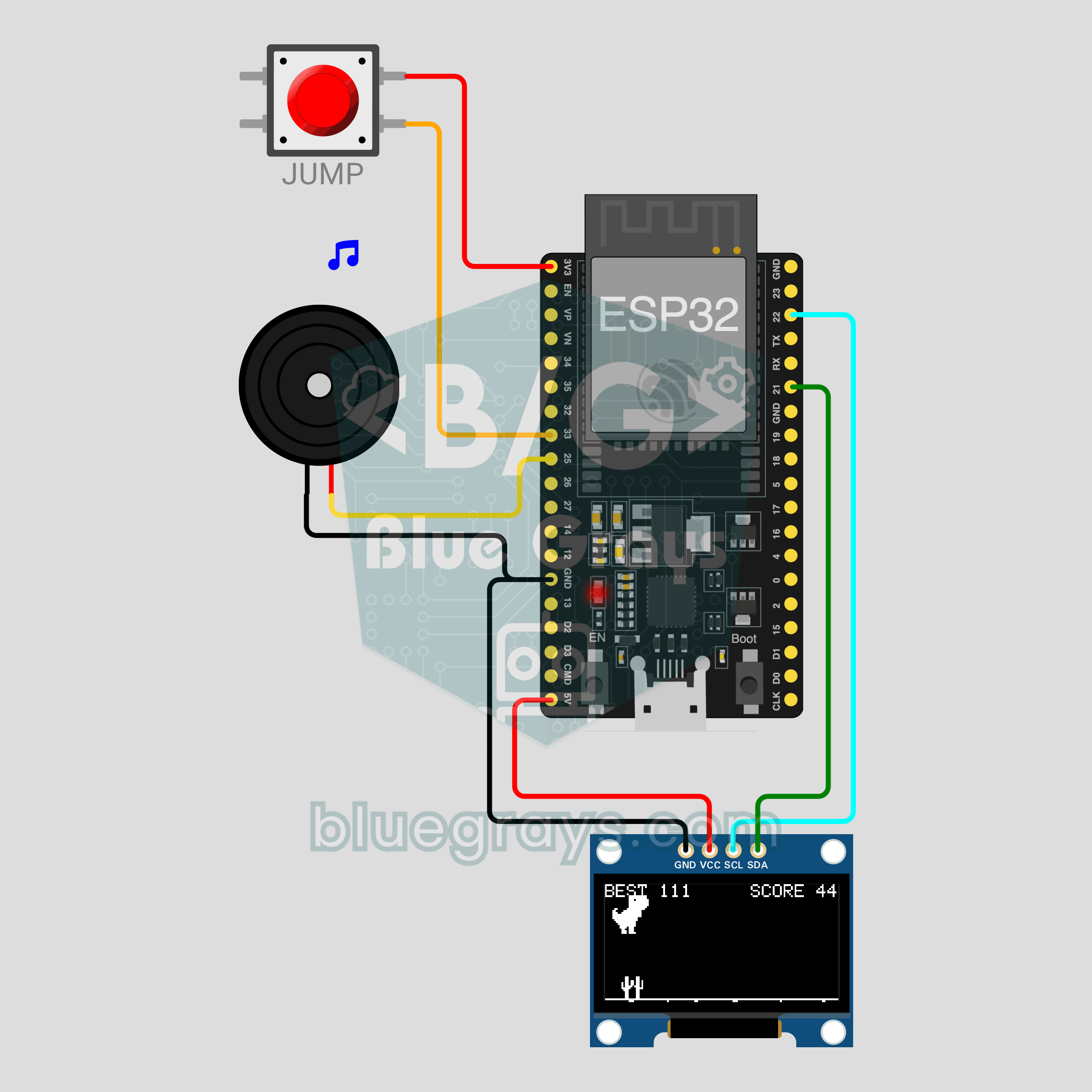
ESP32 T-Rex Run Dino Game (OLED Display + Button + Buzzer)
Chrome's "no internet" dinosaur game, now on your desk! The ESP32 draws a running dino on a 0.96 inch OLED; press the button to jump while the cacti keep speeding up. Score and best score sit on the top line, and the best score is saved to ESP32 flash with Preferences, so it survives a power cut. It is the ESP32 version of the Arduino OLED T-Rex Run project, with a passive buzzer for jump, 100-point and crash sounds.
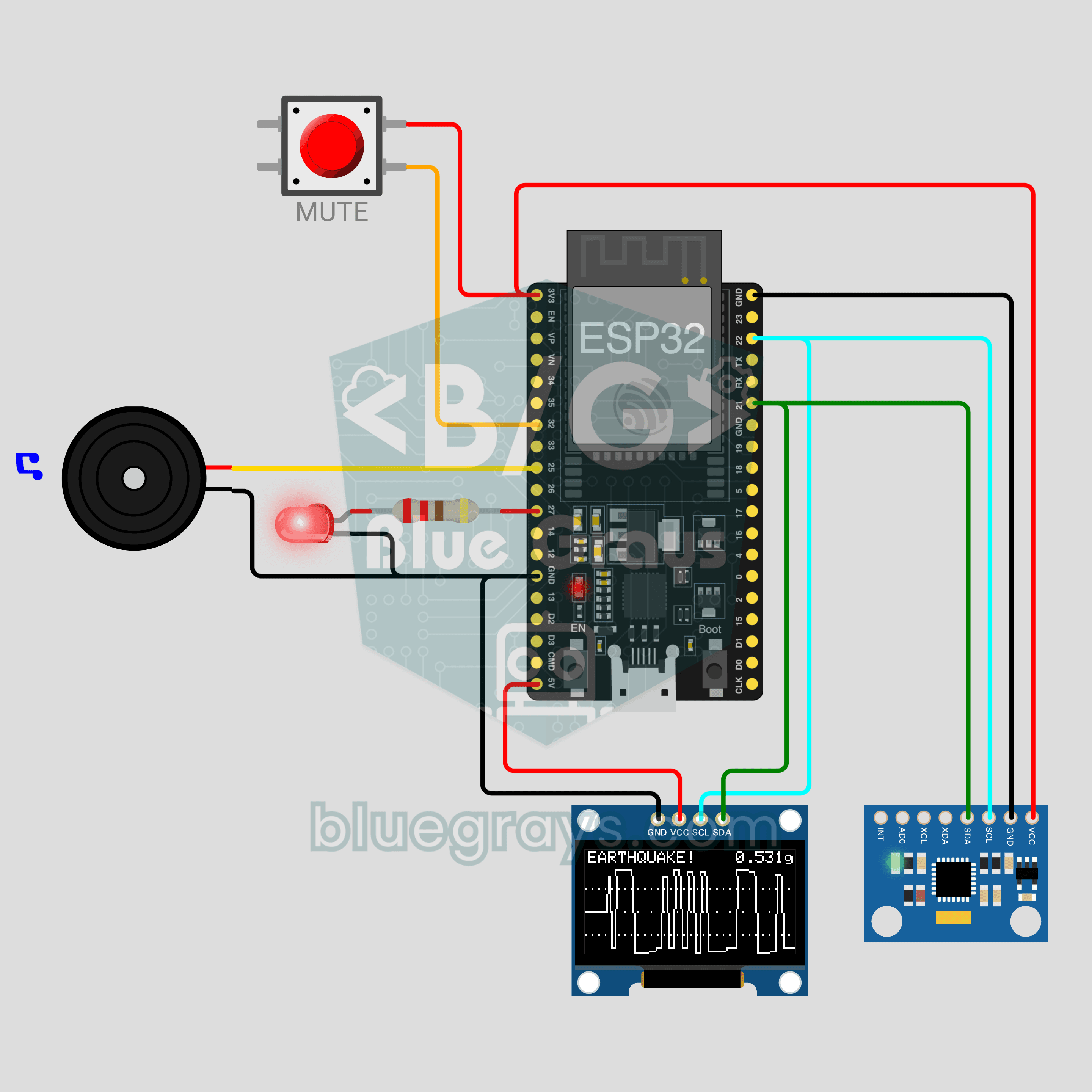
ESP32 Earthquake Shake Alarm (MPU-6050 + OLED Display + Buzzer)
When your desk shakes, this screen notices first! The ESP32 measures vibration with an MPU-6050 accelerometer and draws a live trace that scrolls like a seismograph on a 0.96-inch OLED display. When the shaking passes the threshold, a passive buzzer sounds a siren and the red LED flashes; one button silences and resets it. It is an educational shake meter, not an official earthquake warning.
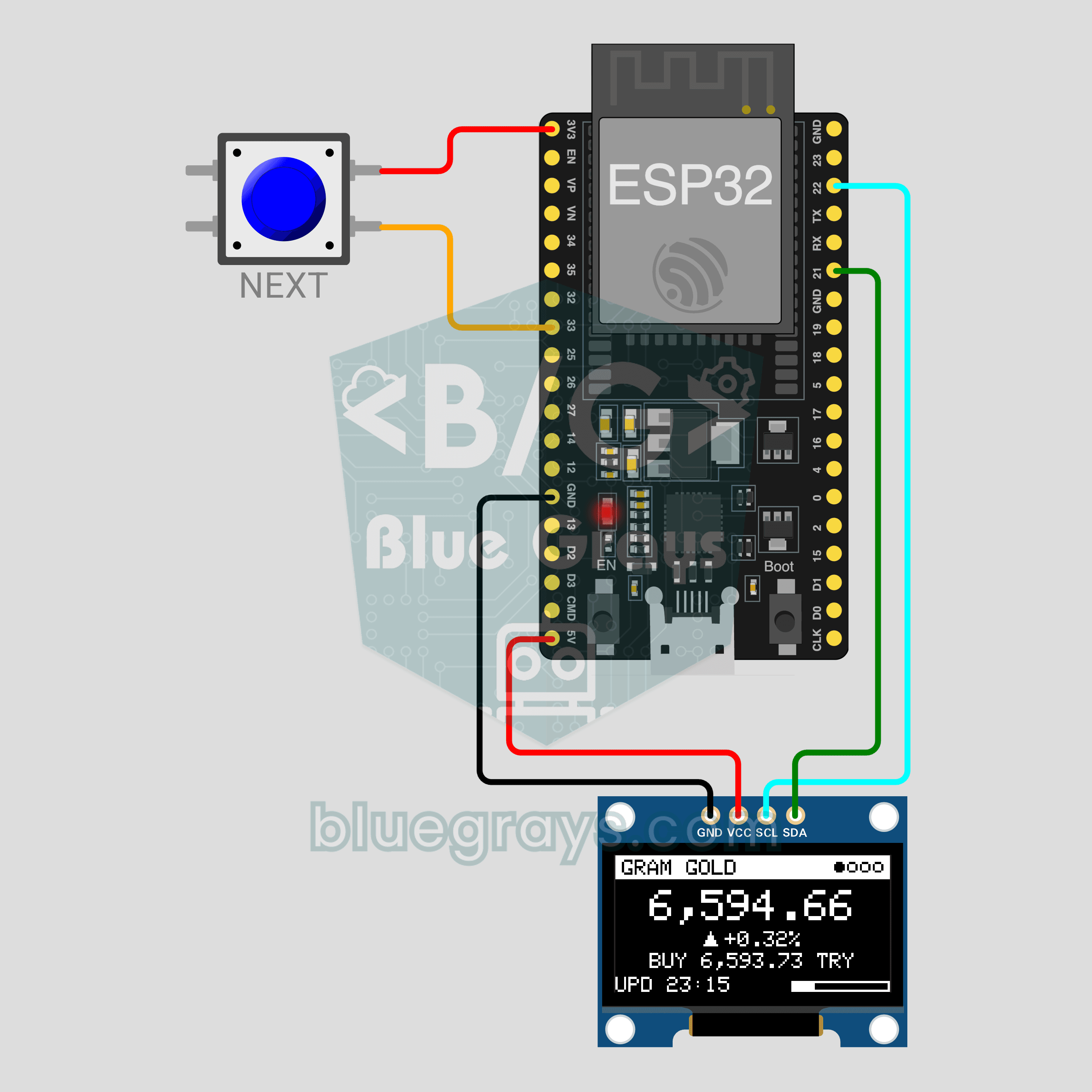
ESP32 Live Gold and Currency Display (Wi-Fi + OLED Display + Button)
What is gold trading at in Turkey right now? No need to check your phone! The ESP32 joins Wi-Fi, pulls gram gold, US dollar and euro prices in Turkish lira from a free, keyless JSON source and shows them on a 0.96 inch OLED. Prices refresh every 60 seconds; the button flips pages and a long press refreshes right away. If the internet drops, the last values stay on screen with an OFFLINE badge.