
EL-18PertengahanPremiumLitar transistor
Driving a Relay: Relay Control with a Transistor and Diode
A relay is a mechanical switch that turns a completely separate circuit on and off with a small current. In this circuit, when you press the button the BC547 feeds current to the relay's coil, the contact closes with a click and the LED lights. The 1N4007 diode connected in reverse across the coil protects the transistor from the voltage spike that appears at turn-off. Here the contact only switches an LED at 5 V: never try mains voltage on a breadboard.
5.0(1)
1 selesai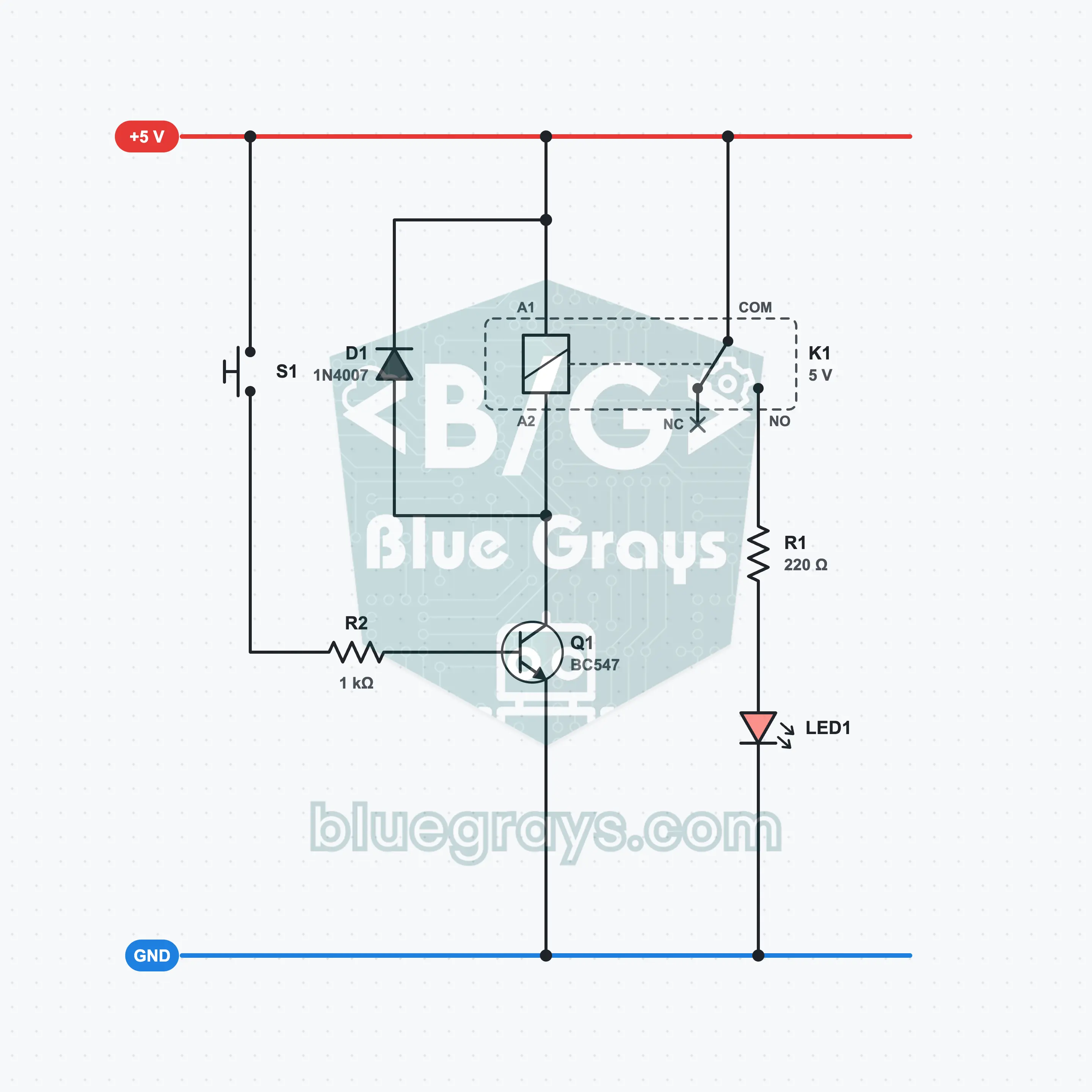
It is built with a 5 V supply, a 5 V single-pole relay, one BC547, one 1N4007 diode, 1 kΩ and 220 Ω resistors, one button and one red LED. Because the relay does not fit a breadboard, it is connected with four female-to-male jumper wires. The button supplies a base current of 4.3 mA, and the transistor switches the coil's current of about 69 mA. The cathode of the diode is at +5 V and its anode is at the collector. What you learn: coil and contact, the NO and NC terminals, the flyback diode, base resistor calculation. The contact is used at low voltage only.
Kandungan Premium
Langkah pemasangan, cara berfungsi dan soalan lazim litar ini terbuka untuk ahli Premium.
- Langkah Pemasangan
- Cara Ia Berfungsi
- Soalan Lazim