
ESP32 Bluetooth RGB LED स्ट्रिप (WS2812B)
अपनी स्ट्रिप का रंग, चमक और इफ़ेक्ट फ़ोन से बदलें: ESP32 अपने बिल्ट-इन Bluetooth से सीधे आपके फ़ोन से जुड़ता है, और WS2812B स्ट्रिप को सिर्फ़ 3 तार चाहिए। यह प्रोजेक्ट ऐप के RGB LED स्ट्रिप Bluetooth टेम्पलेट की स्टेप बाय स्टेप गाइड है। मेरी वर्कशॉप › मेरे डिवाइस › डिवाइस जोड़ें › Bluetooth पर जाएँ, RGB LED स्ट्रिप चुनें और कोड लें से कोड अपलोड करें। इस पेज का Bluetooth पैनल बनाएँ बटन इसी टेम्पलेट के साथ विज़ार्ड खोलता है।
वीडियो
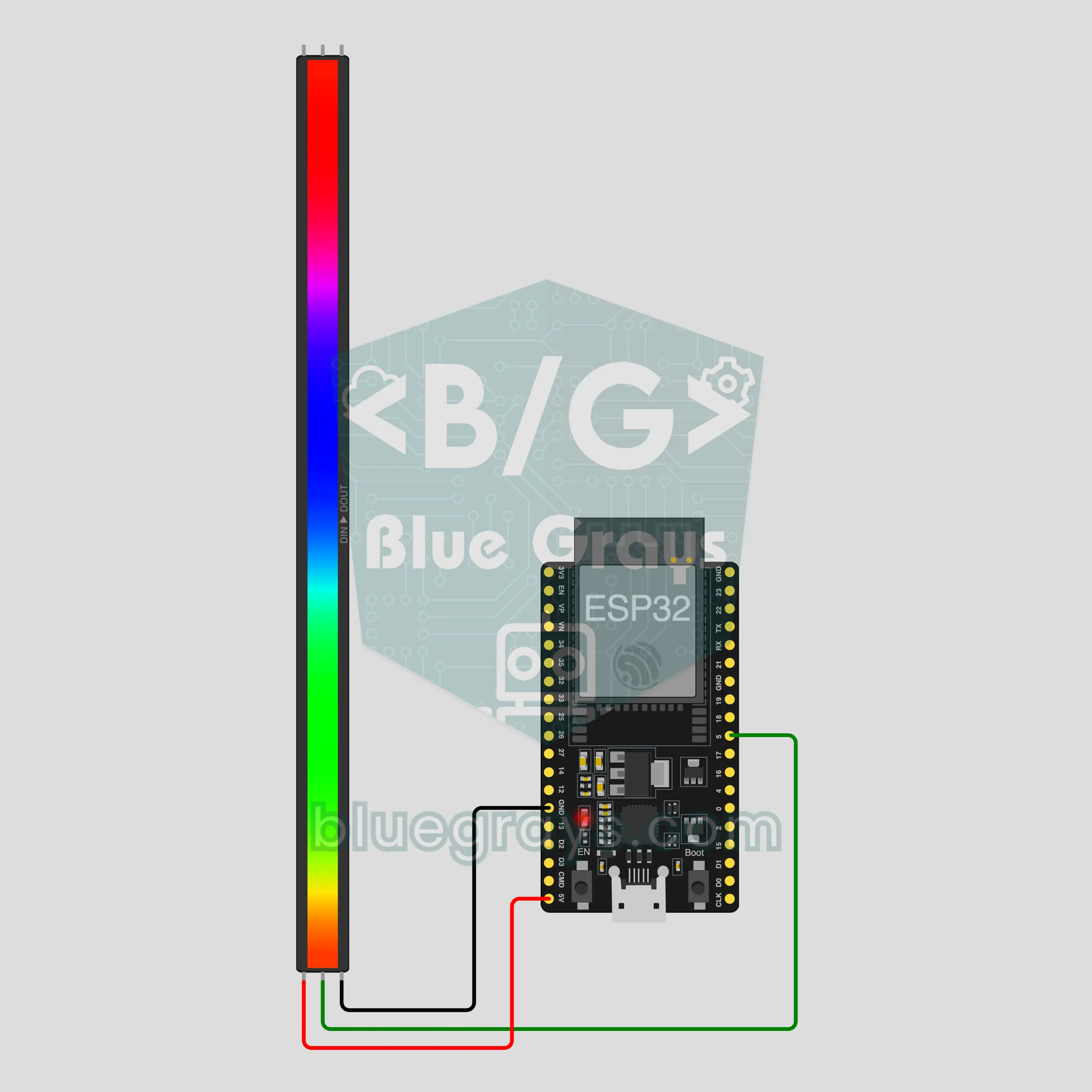
सर्किट डायग्राम
सोर्स कोड
1// ┌───────────────────────────┐
2// │ BlueGrays · bluegrays.com │
3// │ Bluetooth · ESP32         │
4// │ BG-Isik                   │
5// └───────────────────────────┘
6// RGB LED strip
7// Arduino IDE board: ESP32 Dev Module
8// the BLE library comes with the ESP32 board package, nothing extra to install
9
10#include <BLEDevice.h>
11#include <BLEServer.h>
12#include <BLE2902.h>
13#include <Adafruit_NeoPixel.h>  // Library Manager: 'Adafruit NeoPixel'
14
15const char BLE_NAME[] = "BG-Isik";  // the board advertises with this name, the app finds it in the list by it
16
17// Pins: change them here if you wired differently
18const int STRIP_PIN = 5;
19const int LED_COUNT = 30;  // number of LEDs on your strip
20
21void btWrite(const char *text);
22void onValue(const char *key, const char *value);
23void sendAll();
24void onLinkLost();
25
26// ── The app sends "key=value" lines; on "?" the board sends all its values ──
27char line[65];
28uint8_t lineLen = 0;
29unsigned long lastRxMs = 0;
30
31bool is(const char *a, const char *b) { return strcmp(a, b) == 0; }
32bool isOn(const char *v) { return v[0] == '1'; }
33
34void sendText(const char *key, const char *value) {
35  char out[72];
36  snprintf(out, sizeof(out), "%s=%s\n", key, value);
37  btWrite(out);
38}
39
40void sendInt(const char *key, long value) {
41  char text[12];
42  snprintf(text, sizeof(text), "%ld", value);
43  sendText(key, text);
44}
45
46void sendFloat(const char *key, float value) {
47  char text[16];
48  dtostrf(value, 1, 1, text);
49  sendText(key, text);
50}
51
52void handleLine(char *text) {
53  char *eq = strchr(text, '=');
54  if (eq == nullptr) {
55    if (text[strlen(text) - 1] == '?') {
56      btWrite("@v=1.0\n");  // the "@v" line tells the app the code version
57      sendAll();
58    }
59    return;
60  }
61  *eq = '\0';
62  onValue(text, eq + 1);
63}
64
65void feed(char c) {
66  lastRxMs = millis();
67  if (c == '\n' || c == '\r') {
68    if (lineLen == 0) return;
69    line[lineLen] = '\0';
70    lineLen = 0;
71    handleLine(line);
72  } else if (lineLen < sizeof(line) - 1) {
73    line[lineLen++] = c;
74  }
75}
76
77// ── Bluetooth (Nordic UART) ──
78#define UART_SERVICE "6E400001-B5A3-F393-E0A9-E50E24DCCA9E"
79#define UART_RX "6E400002-B5A3-F393-E0A9-E50E24DCCA9E"
80#define UART_TX "6E400003-B5A3-F393-E0A9-E50E24DCCA9E"
81
82BLECharacteristic *txChar = nullptr;
83volatile bool linked = false;
84volatile bool linkLost = false;
85// incoming bytes move from the Bluetooth task to loop() through a small ring buffer
86const int RX_SIZE = 256;
87volatile uint8_t rxBuf[RX_SIZE];
88volatile int rxHead = 0, rxTail = 0;
89
90class ServerEvents : public BLEServerCallbacks {
91  void onConnect(BLEServer *server) override { linked = true; }
92  void onDisconnect(BLEServer *server) override { linked = false; linkLost = true; }
93};
94
95class RxEvents : public BLECharacteristicCallbacks {
96  void onWrite(BLECharacteristic *c) override {
97    auto v = c->getValue();
98    for (size_t i = 0; i < v.length(); i++) {
99      int next = (rxHead + 1) % RX_SIZE;
100      if (next == rxTail) break;
101      rxBuf[rxHead] = (uint8_t)v[i];
102      rxHead = next;
103    }
104  }
105};
106
107// lines go out in 20-byte packets (works with every phone)
108void btWrite(const char *text) {
109  if (!linked || txChar == nullptr) return;
110  size_t n = strlen(text);
111  for (size_t i = 0; i < n; i += 20) {
112    size_t len = n - i < 20 ? n - i : 20;
113    txChar->setValue((uint8_t *)text + i, len);
114    txChar->notify();
115    delay(4);
116  }
117}
118
119void btBegin() {
120  BLEDevice::init(BLE_NAME);
121  BLEServer *server = BLEDevice::createServer();
122  server->setCallbacks(new ServerEvents());
123  BLEService *uart = server->createService(UART_SERVICE);
124  txChar = uart->createCharacteristic(UART_TX, BLECharacteristic::PROPERTY_NOTIFY);
125  txChar->addDescriptor(new BLE2902());
126  BLECharacteristic *rx = uart->createCharacteristic(UART_RX, BLECharacteristic::PROPERTY_WRITE | BLECharacteristic::PROPERTY_WRITE_NR);
127  rx->setCallbacks(new RxEvents());
128  uart->start();
129  BLEAdvertisementData adv;
130  adv.setFlags(0x06);
131  adv.setCompleteServices(BLEUUID(UART_SERVICE));
132  BLEAdvertisementData scan;
133  scan.setName(BLE_NAME);
134  BLEAdvertising *advertising = BLEDevice::getAdvertising();
135  advertising->setAdvertisementData(adv);
136  advertising->setScanResponseData(scan);
137  BLEDevice::startAdvertising();
138}
139
140void btPoll() {
141  while (rxTail != rxHead) {
142    char c = (char)rxBuf[rxTail];
143    rxTail = (rxTail + 1) % RX_SIZE;
144    feed(c);
145  }
146  if (linkLost) {
147    linkLost = false;
148    onLinkLost();
149    delay(100);
150    BLEDevice::startAdvertising();
151  }
152}
153
154// ── ESP32 ──
155Adafruit_NeoPixel strip(LED_COUNT, STRIP_PIN, NEO_GRB + NEO_KHZ800);
156bool stripOn = false;
157uint8_t cr = 255, cg = 255, cb = 255;
158int brightness = 70;
159char effect[16] = "sabit";
160uint16_t hue = 0;
161unsigned long lastFrameMs = 0;
162
163uint8_t level() { return map(brightness, 0, 100, 0, 255); }
164
165// gamma correction: colors look on the LEDs like they do on screen
166void fillColor(uint32_t color, uint8_t bright) {
167  strip.setBrightness(bright);
168  strip.fill(strip.gamma32(color));
169  strip.show();
170}
171
172void paint() {
173  if (!stripOn) { strip.clear(); strip.show(); return; }
174  fillColor(strip.Color(cr, cg, cb), level());
175}
176
177void onValue(const char *key, const char *value) {
178  if (is(key, "acik")) {
179    stripOn = isOn(value);
180  } else if (is(key, "renk") && value[0] == '#' && strlen(value) == 7) {
181    long c = strtol(value + 1, nullptr, 16);
182    cr = c >> 16; cg = (c >> 8) & 0xFF; cb = c & 0xFF;
183  } else if (is(key, "parlaklik")) {
184    brightness = constrain(atoi(value), 0, 100);
185  } else if (is(key, "efekt")) {
186    strncpy(effect, value, sizeof(effect) - 1);
187  }
188  paint();
189}
190
191void sendAll() {
192  char hex[8];
193  snprintf(hex, sizeof(hex), "#%02X%02X%02X", cr, cg, cb);
194  sendInt("acik", stripOn);
195  sendText("renk", hex);
196  sendInt("parlaklik", brightness);
197  sendText("efekt", effect);
198}
199
200void onLinkLost() {
201}
202
203void setup() {
204  Serial.begin(115200);
205  strip.begin();
206  paint();
207  btBegin();
208  Serial.print(F("BlueGrays Bluetooth: "));
209  Serial.println(BLE_NAME);
210}
211
212void loop() {
213  btPoll();
214  if (stripOn && !is(effect, "sabit")) {
215    // the effect pauses for a moment while a command arrives (interrupts are off while the strip updates)
216    if (millis() - lastRxMs > 150 && millis() - lastFrameMs >= 30) {
217      lastFrameMs = millis();
218      if (is(effect, "gokkusagi")) {  // a rainbow flows along the strip
219        hue += 512;
220        strip.setBrightness(level());
221        for (int i = 0; i < LED_COUNT; i++) strip.setPixelColor(i, strip.gamma32(strip.ColorHSV(hue + i * 65536L / LED_COUNT)));
222        strip.show();
223      } else if (is(effect, "nefes")) {  // slowly fades out and in
224        float wave = (sin(millis() / 600.0) + 1.0) / 2.0;
225        fillColor(strip.Color(cr, cg, cb), level() * (0.15 + 0.85 * wave));
226      } else if (is(effect, "yanip_sonme")) {  // blinks every half second
227        fillColor(strip.Color(cr, cg, cb), (millis() / 500) % 2 ? level() : 0);
228      } else if (is(effect, "renk_dongusu")) {  // whole strip one color, smooth hue shift
229        hue += 128;
230        fillColor(strip.ColorHSV(hue), level());
231      }
232    }
233  }
234}
235FAQ
क्या यह iPhone के साथ चलता है?
हाँ। प्रोजेक्ट ESP32 का बिल्ट-इन Bluetooth Low Energy (BLE) इस्तेमाल करता है, जो iPhone और Android दोनों पर चलता है। iPhone, HC-05 या HC-06 जैसे क्लासिक Bluetooth मॉड्यूल से कनेक्ट नहीं हो सकता, इसीलिए यहाँ कोई अलग मॉड्यूल नहीं है। बोर्ड को फ़ोन की Bluetooth सेटिंग्स में पेयर करने की कोशिश न करें; कनेक्शन सिर्फ़ BlueGrays ऐप बनाता है।
कितने LED जोड़े जा सकते हैं, और कैसी पावर सप्लाई चाहिए?
पूरी सफ़ेद रोशनी पर हर LED 60 mA तक लेता है, इसलिए 30 LED लगभग 1.8 A तक पहुँचते हैं। कंप्यूटर का USB पोर्ट इतना नहीं दे सकता, इसलिए USB पर छोटे टेस्ट के लिए चमक लगभग 20 रखें। रोज़ के इस्तेमाल के लिए स्ट्रिप को अलग 5 V 2 A एडैप्टर से पावर दें और उसका GND, ESP32 के GND से जोड़ें। लंबी स्ट्रिप के लिए कोड में LED_COUNT बदलें और एडैप्टर को हर LED पर 60 mA के हिसाब से चुनें। स्ट्रिप के इनपुट पर 1000 µF कैपेसिटर और डेटा लाइन में सीरीज़ में 330 Ω रेज़िस्टर स्ट्रिप को बचाते हैं।
रंग स्क्रीन से अलग क्यों दिखते हैं?
LED की चमक वैल्यू के साथ सीधी रेखा में बढ़ती है, लेकिन आपकी आँख रोशनी को ऐसे नहीं देखती; करेक्शन के बिना रंग फीके और सफ़ेद-से दिखते हैं। इसीलिए कोड हर रंग को gamma32 से ठीक करता है। गहरे और पेस्टल शेड स्क्रीन के करीब आ जाते हैं, पर बिल्कुल एक जैसे कभी नहीं होते। बहुत कम चमक पर रंग खिसक जाते हैं और पीले व नारंगी जैसे मिले-जुले शेड फीके पड़ते हैं; लगभग 40 से ऊपर फ़र्क कम हो जाता है।
बिजली जाने के बाद स्ट्रिप क्या करती है?
बोर्ड हमेशा स्ट्रिप बंद रखकर शुरू होता है: रंग सफ़ेद पर, चमक 70 पर और इफ़ेक्ट एक रंग पर लौट जाता है, क्योंकि वैल्यू बोर्ड पर सेव नहीं होतीं। ऐप दोबारा कनेक्ट होने पर पैनल बोर्ड की भेजी मौजूदा वैल्यू दिखाता है, इसलिए बस रोशनी स्विच चालू करें। अगर सिर्फ़ फ़ोन डिस्कनेक्ट हो, तो स्ट्रिप पहले की तरह जलती रहती है।