
Alarm czujnika gazu i dymu MQ-2 z ESP32
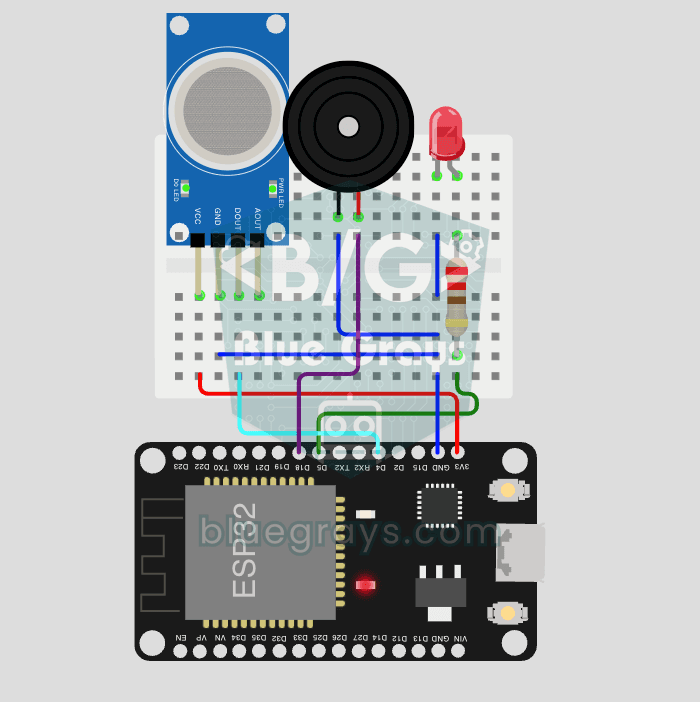
W tym projekcie moduł czujnika gazu MQ-2 wykrywa gazy palne (LPG, metan, propan) i dym, a po wykryciu pasywny buzzer gra alarm przypominający syrenę. Cyfrowe wyjście progowe czujnika (DO) jest podłączone do GPIO 4 w ESP32; gdy gaz albo dym przekroczy próg, DO przechodzi w stan LOW i włącza się alarm. Czułość ustawia się potencjometrem na module. Pasywny buzzer jest sterowany przez tone(), co daje efekt syreny na dwóch częstotliwościach.

Film
Schemat układu
Kod źródłowy
1// ─────────────────────────────────────────
2//   BlueGrays · bluegrays.com
3//   ESP32 MQ-2 Gas/Smoke Detector Alarm
4// ─────────────────────────────────────────
5// Reads the digital threshold output (DO) of the MQ-2 module. When gas or
6// smoke passes the threshold, the warning LED turns on and the passive
7// buzzer plays a siren switching between 800 and 1200 Hz every 0.2 s. Set
8// the threshold with the trimpot on the module (Arduino Core 3.0+).
9//
10// Pins:
11//   GPIO 4  -> MQ-2 DO (digital threshold output)
12//   GPIO 18 -> Buzzer + leg
13//   GPIO 5  -> Red LED (with a 220 ohm resistor)
14//   MQ-2 VCC -> MQ-2 VCC -> 5V (VIN), GND -> GND
15
16// Pin definitions
17const int MQ2_DO_PIN  = 4;    // MQ-2 D0 (digital threshold out)
18const int BUZZER_PIN  = 18;   // Passive buzzer
19const int LED_PIN     = 5;    // Warning LED + 220R
20
21// Warm-up time (ms): the MQ-2 heater needs minutes to warm up. In Wokwi 2000 is enough.
22const unsigned long WARMUP_MS = 60000;
23bool warmedUp = false;        // Is the warm-up over
24
25void setup() {
26  pinMode(MQ2_DO_PIN, INPUT);
27  pinMode(BUZZER_PIN, OUTPUT);
28  pinMode(LED_PIN, OUTPUT);
29  digitalWrite(BUZZER_PIN, LOW);
30  digitalWrite(LED_PIN, LOW);
31}
32
33void loop() {
34  // Warm-up: the DO reading is ignored, the LED blinks slowly without blocking
35  if (!warmedUp) {
36    if (millis() < WARMUP_MS) {
37      digitalWrite(LED_PIN, (millis() / 500) % 2);   // 0.5 s on, 0.5 s off
38      return;
39    }
40    warmedUp = true;
41  }
42
43  // MQ-2 D0 is normally HIGH and goes LOW above the threshold
44  int gasState = digitalRead(MQ2_DO_PIN);
45
46  if (gasState == LOW) {
47    // Alarm: the LED turns on, the buzzer plays a two-tone siren
48    digitalWrite(LED_PIN, HIGH);
49    tone(BUZZER_PIN, 800);    // Low tone
50    delay(200);
51    tone(BUZZER_PIN, 1200);   // High tone
52    delay(200);
53  } else {
54    // Idle: LED and buzzer off
55    digitalWrite(LED_PIN, LOW);
56    noTone(BUZZER_PIN);
57    delay(50);
58  }
59}
60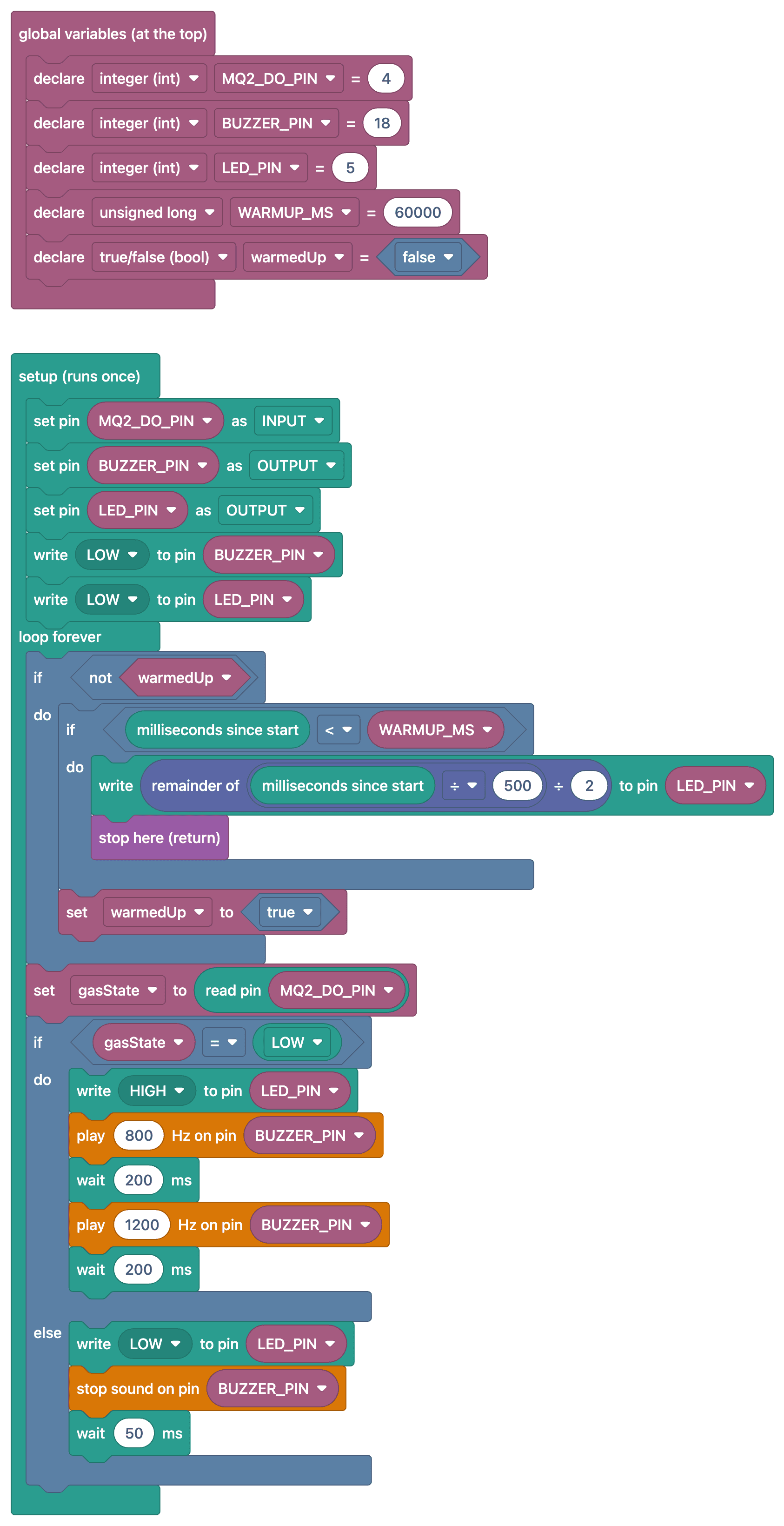
FAQ
Jakie gazy wykrywa MQ-2?
MQ-2 reaguje na LPG, propan, metan, wodór, opary alkoholu i dym. Nie odróżnia poszczególnych gazów; wykrywa tylko ogólny wzrost stężenia.
Czy wyjście analogowe MQ-2 można podłączyć bezpośrednio do ESP32?
MQ-2 jest zasilany z 5 V, a jego wyjście analogowe może dochodzić do 5 V. Wejście ADC w ESP32 przyjmuje najwyżej 3,3 V, więc trzeba użyć dzielnika napięcia (np. 10 kΩ + 20 kΩ).
Zaraz po włączeniu czujnik pokazuje wysoki odczyt. Dlaczego?
Grzałka czujników MQ potrzebuje kilku minut na ustabilizowanie się; w tym czasie odczyty są wysokie. Wyłączenie alarmu na kilka minut po starcie zapobiega fałszywym alarmom.
Jak powstaje efekt syreny?
Pasywny buzzer jest sterowany przez `tone()` tak, aby szybko przełączał się między dwiema różnymi częstotliwościami (np. 800 Hz i 1200 Hz). To przełączanie naśladuje klasyczny dźwięk alarmu.