
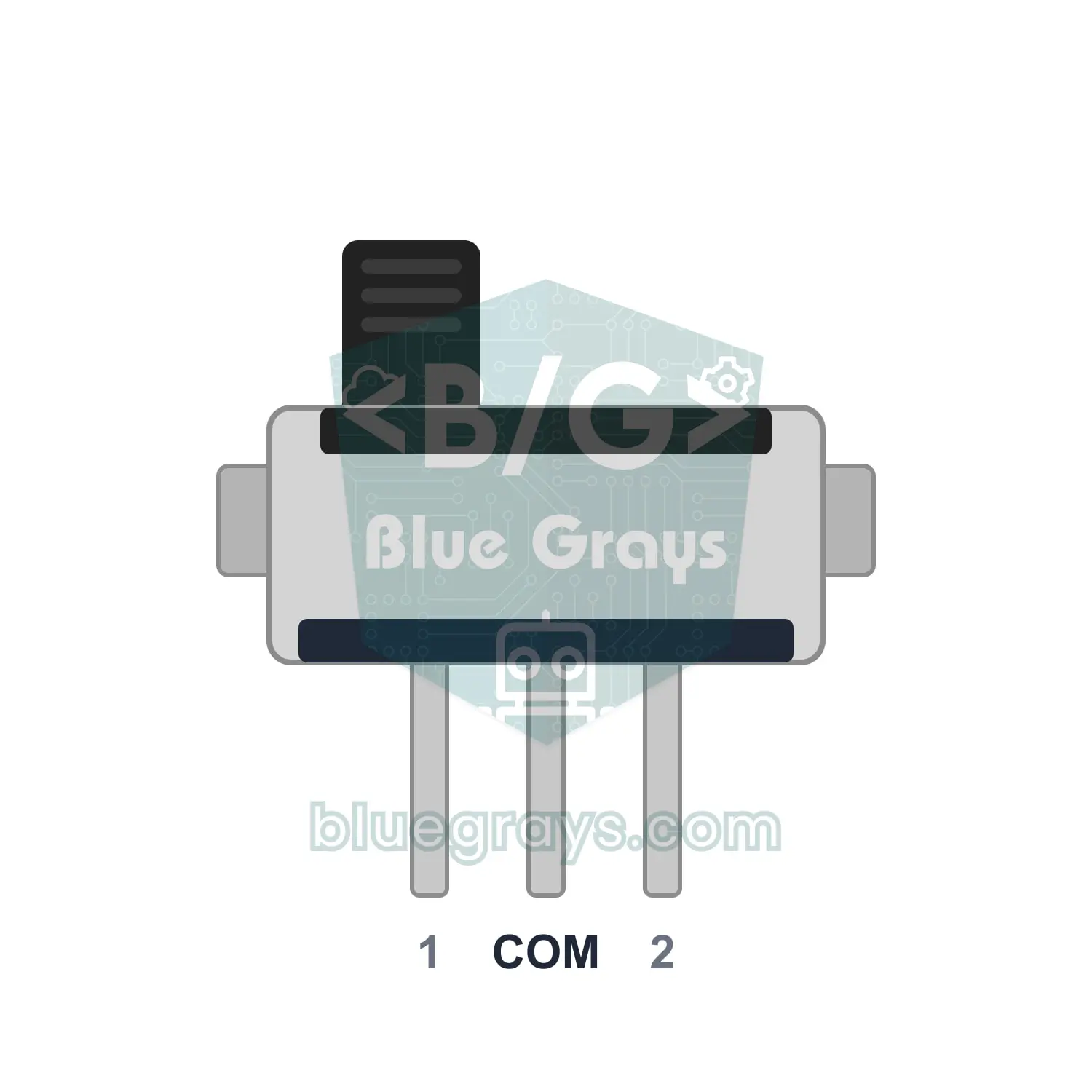
The slide switch changes position when you push its small lever left or right, and it stays where you leave it. The type used most on breadboards has three pins (SPDT): the middle pin is the common terminal, and the lever connects it to the outer pin on the side it slides towards. That gives it two jobs: use the common and one outer pin and it is a power switch that opens and closes the circuit; wire the outer pins to the positive and ground rails and the common to an input, and you feed that input a 1 or a 0. Unlike a push button, it does not spring back when you let go. Models with 2.54 mm pin spacing sit straight in a breadboard. It is made for low-voltage, low-current circuits and must not be used to switch mains voltage. The metal tabs on the sides of the body are not electrical terminals; they only hold the switch in place.