
ESP32 Bluetooth RGB LED Strip (WS2812B)
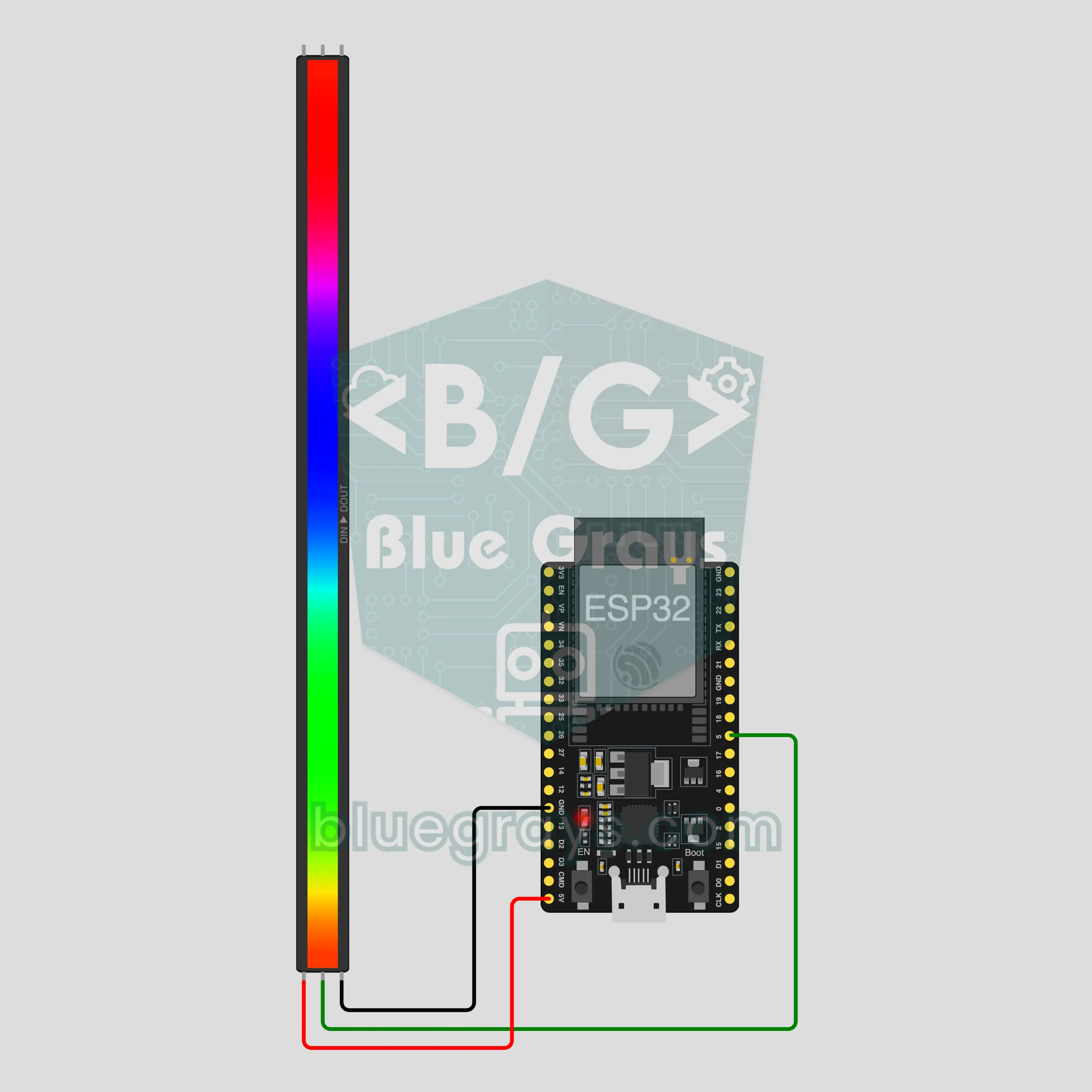
Change your strip's color, brightness and effect from your phone: the ESP32 connects straight to your phone over its built-in Bluetooth, and the WS2812B strip needs only 3 wires. This project is the step-by-step guide to the RGB LED strip Bluetooth template in the app. Go to Workshop › Devices › Add a device › Bluetooth, pick RGB LED strip and upload the code with Get the code. The Set up as a Bluetooth panel button on this page opens the wizard with this template.
Video
Circuit Diagram
Source Code
1// ┌───────────────────────────┐
2// │ BlueGrays · bluegrays.com │
3// │ Bluetooth · ESP32         │
4// │ BG-Isik                   │
5// └───────────────────────────┘
6// RGB LED strip
7// Arduino IDE board: ESP32 Dev Module
8// the BLE library comes with the ESP32 board package, nothing extra to install
9
10#include <BLEDevice.h>
11#include <BLEServer.h>
12#include <BLE2902.h>
13#include <Adafruit_NeoPixel.h>  // Library Manager: 'Adafruit NeoPixel'
14
15const char BLE_NAME[] = "BG-Isik";  // the board advertises with this name, the app finds it in the list by it
16
17// Pins: change them here if you wired differently
18const int STRIP_PIN = 5;
19const int LED_COUNT = 30;  // number of LEDs on your strip
20
21void btWrite(const char *text);
22void onValue(const char *key, const char *value);
23void sendAll();
24void onLinkLost();
25
26// ── The app sends "key=value" lines; on "?" the board sends all its values ──
27char line[65];
28uint8_t lineLen = 0;
29unsigned long lastRxMs = 0;
30
31bool is(const char *a, const char *b) { return strcmp(a, b) == 0; }
32bool isOn(const char *v) { return v[0] == '1'; }
33
34void sendText(const char *key, const char *value) {
35  char out[72];
36  snprintf(out, sizeof(out), "%s=%s\n", key, value);
37  btWrite(out);
38}
39
40void sendInt(const char *key, long value) {
41  char text[12];
42  snprintf(text, sizeof(text), "%ld", value);
43  sendText(key, text);
44}
45
46void sendFloat(const char *key, float value) {
47  char text[16];
48  dtostrf(value, 1, 1, text);
49  sendText(key, text);
50}
51
52void handleLine(char *text) {
53  char *eq = strchr(text, '=');
54  if (eq == nullptr) {
55    if (text[strlen(text) - 1] == '?') {
56      btWrite("@v=1.0\n");  // the "@v" line tells the app the code version
57      sendAll();
58    }
59    return;
60  }
61  *eq = '\0';
62  onValue(text, eq + 1);
63}
64
65void feed(char c) {
66  lastRxMs = millis();
67  if (c == '\n' || c == '\r') {
68    if (lineLen == 0) return;
69    line[lineLen] = '\0';
70    lineLen = 0;
71    handleLine(line);
72  } else if (lineLen < sizeof(line) - 1) {
73    line[lineLen++] = c;
74  }
75}
76
77// ── Bluetooth (Nordic UART) ──
78#define UART_SERVICE "6E400001-B5A3-F393-E0A9-E50E24DCCA9E"
79#define UART_RX "6E400002-B5A3-F393-E0A9-E50E24DCCA9E"
80#define UART_TX "6E400003-B5A3-F393-E0A9-E50E24DCCA9E"
81
82BLECharacteristic *txChar = nullptr;
83volatile bool linked = false;
84volatile bool linkLost = false;
85// incoming bytes move from the Bluetooth task to loop() through a small ring buffer
86const int RX_SIZE = 256;
87volatile uint8_t rxBuf[RX_SIZE];
88volatile int rxHead = 0, rxTail = 0;
89
90class ServerEvents : public BLEServerCallbacks {
91  void onConnect(BLEServer *server) override { linked = true; }
92  void onDisconnect(BLEServer *server) override { linked = false; linkLost = true; }
93};
94
95class RxEvents : public BLECharacteristicCallbacks {
96  void onWrite(BLECharacteristic *c) override {
97    auto v = c->getValue();
98    for (size_t i = 0; i < v.length(); i++) {
99      int next = (rxHead + 1) % RX_SIZE;
100      if (next == rxTail) break;
101      rxBuf[rxHead] = (uint8_t)v[i];
102      rxHead = next;
103    }
104  }
105};
106
107// lines go out in 20-byte packets (works with every phone)
108void btWrite(const char *text) {
109  if (!linked || txChar == nullptr) return;
110  size_t n = strlen(text);
111  for (size_t i = 0; i < n; i += 20) {
112    size_t len = n - i < 20 ? n - i : 20;
113    txChar->setValue((uint8_t *)text + i, len);
114    txChar->notify();
115    delay(4);
116  }
117}
118
119void btBegin() {
120  BLEDevice::init(BLE_NAME);
121  BLEServer *server = BLEDevice::createServer();
122  server->setCallbacks(new ServerEvents());
123  BLEService *uart = server->createService(UART_SERVICE);
124  txChar = uart->createCharacteristic(UART_TX, BLECharacteristic::PROPERTY_NOTIFY);
125  txChar->addDescriptor(new BLE2902());
126  BLECharacteristic *rx = uart->createCharacteristic(UART_RX, BLECharacteristic::PROPERTY_WRITE | BLECharacteristic::PROPERTY_WRITE_NR);
127  rx->setCallbacks(new RxEvents());
128  uart->start();
129  BLEAdvertisementData adv;
130  adv.setFlags(0x06);
131  adv.setCompleteServices(BLEUUID(UART_SERVICE));
132  BLEAdvertisementData scan;
133  scan.setName(BLE_NAME);
134  BLEAdvertising *advertising = BLEDevice::getAdvertising();
135  advertising->setAdvertisementData(adv);
136  advertising->setScanResponseData(scan);
137  BLEDevice::startAdvertising();
138}
139
140void btPoll() {
141  while (rxTail != rxHead) {
142    char c = (char)rxBuf[rxTail];
143    rxTail = (rxTail + 1) % RX_SIZE;
144    feed(c);
145  }
146  if (linkLost) {
147    linkLost = false;
148    onLinkLost();
149    delay(100);
150    BLEDevice::startAdvertising();
151  }
152}
153
154// ── ESP32 ──
155Adafruit_NeoPixel strip(LED_COUNT, STRIP_PIN, NEO_GRB + NEO_KHZ800);
156bool stripOn = false;
157uint8_t cr = 255, cg = 255, cb = 255;
158int brightness = 70;
159char effect[16] = "sabit";
160uint16_t hue = 0;
161unsigned long lastFrameMs = 0;
162
163uint8_t level() { return map(brightness, 0, 100, 0, 255); }
164
165// gamma correction: colors look on the LEDs like they do on screen
166void fillColor(uint32_t color, uint8_t bright) {
167  strip.setBrightness(bright);
168  strip.fill(strip.gamma32(color));
169  strip.show();
170}
171
172void paint() {
173  if (!stripOn) { strip.clear(); strip.show(); return; }
174  fillColor(strip.Color(cr, cg, cb), level());
175}
176
177void onValue(const char *key, const char *value) {
178  if (is(key, "acik")) {
179    stripOn = isOn(value);
180  } else if (is(key, "renk") && value[0] == '#' && strlen(value) == 7) {
181    long c = strtol(value + 1, nullptr, 16);
182    cr = c >> 16; cg = (c >> 8) & 0xFF; cb = c & 0xFF;
183  } else if (is(key, "parlaklik")) {
184    brightness = constrain(atoi(value), 0, 100);
185  } else if (is(key, "efekt")) {
186    strncpy(effect, value, sizeof(effect) - 1);
187  }
188  paint();
189}
190
191void sendAll() {
192  char hex[8];
193  snprintf(hex, sizeof(hex), "#%02X%02X%02X", cr, cg, cb);
194  sendInt("acik", stripOn);
195  sendText("renk", hex);
196  sendInt("parlaklik", brightness);
197  sendText("efekt", effect);
198}
199
200void onLinkLost() {
201}
202
203void setup() {
204  Serial.begin(115200);
205  strip.begin();
206  paint();
207  btBegin();
208  Serial.print(F("BlueGrays Bluetooth: "));
209  Serial.println(BLE_NAME);
210}
211
212void loop() {
213  btPoll();
214  if (stripOn && !is(effect, "sabit")) {
215    // the effect pauses for a moment while a command arrives (interrupts are off while the strip updates)
216    if (millis() - lastRxMs > 150 && millis() - lastFrameMs >= 30) {
217      lastFrameMs = millis();
218      if (is(effect, "gokkusagi")) {  // a rainbow flows along the strip
219        hue += 512;
220        strip.setBrightness(level());
221        for (int i = 0; i < LED_COUNT; i++) strip.setPixelColor(i, strip.gamma32(strip.ColorHSV(hue + i * 65536L / LED_COUNT)));
222        strip.show();
223      } else if (is(effect, "nefes")) {  // slowly fades out and in
224        float wave = (sin(millis() / 600.0) + 1.0) / 2.0;
225        fillColor(strip.Color(cr, cg, cb), level() * (0.15 + 0.85 * wave));
226      } else if (is(effect, "yanip_sonme")) {  // blinks every half second
227        fillColor(strip.Color(cr, cg, cb), (millis() / 500) % 2 ? level() : 0);
228      } else if (is(effect, "renk_dongusu")) {  // whole strip one color, smooth hue shift
229        hue += 128;
230        fillColor(strip.ColorHSV(hue), level());
231      }
232    }
233  }
234}
235FAQ
Does it work with an iPhone?
Yes. The project uses the ESP32's built-in Bluetooth Low Energy (BLE), which works on both iPhone and Android. An iPhone cannot connect to classic Bluetooth modules like the HC-05 or HC-06, which is why there is no extra module here. Do not try to pair the board in your phone's Bluetooth settings; only the BlueGrays app makes the connection.
How many LEDs can I connect, and what power supply do I need?
Each LED draws up to 60 mA at full white, so 30 LEDs come to about 1.8 A. A computer's USB port cannot supply that, so for a quick test over USB keep the brightness around 20. For everyday use, power the strip from a separate 5 V 2 A adapter and connect its GND to the ESP32's GND. For a longer strip, change LED_COUNT in the code and size the adapter at 60 mA per LED. A 1000 µF capacitor at the strip input and a 330 Ω resistor in series with the data line protect the strip.
Why do the colors look different from the screen?
An LED's brightness rises in a straight line with the value, but your eye does not see light that way; without correction, colors look washed out and whitish. That is why the code corrects every color with gamma32. Dark and pastel shades get close to the screen, but never identical. At very low brightness colors shift and mixed shades like yellow and orange fade; above about 40 the difference shrinks.
What does the strip do after a power cut?
The board always starts with the strip off: the color goes back to white, the brightness to 70 and the effect to Solid, because the values are not stored on the board. When the app reconnects, the panel shows the current values the board sends, so just turn on the Light switch. If only the phone disconnects, the strip keeps shining as it was.