
ESP32 MQ-2 Gas/Smoke Detector Alarm
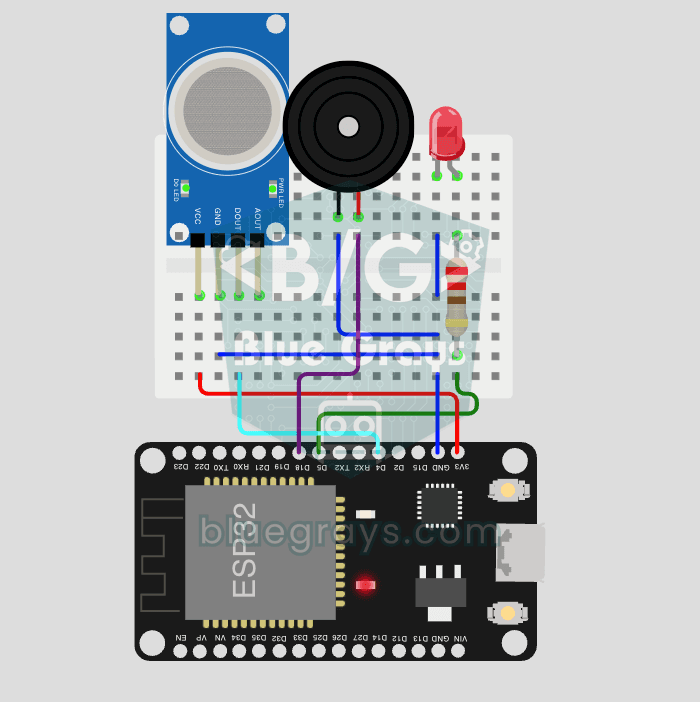
In this project, combustible gas (LPG, methane, propane) and smoke detection is performed using an MQ-2 gas sensor module, and a siren-like alarm is played through a passive buzzer upon detection. The sensor's digital threshold output (DO) is connected to GPIO 4 on the ESP32; when gas or smoke exceeds the threshold, DO goes LOW and the alarm is triggered. Sensitivity is adjusted via the module's potentiometer. The passive buzzer is driven using `tone()` to produce a two-frequency siren effect.

Video
Circuit Diagram
Source Code
1// ─────────────────────────────────────────
2//   BlueGrays · bluegrays.com
3//   ESP32 MQ-2 Gas/Smoke Detector Alarm
4// ─────────────────────────────────────────
5// Reads the digital threshold output (DO) of the MQ-2 module. When gas or
6// smoke passes the threshold, the warning LED turns on and the passive
7// buzzer plays a siren switching between 800 and 1200 Hz every 0.2 s. Set
8// the threshold with the trimpot on the module (Arduino Core 3.0+).
9//
10// Pins:
11//   GPIO 4  -> MQ-2 DO (digital threshold output)
12//   GPIO 18 -> Buzzer + leg
13//   GPIO 5  -> Red LED (with a 220 ohm resistor)
14//   MQ-2 VCC -> MQ-2 VCC -> 5V (VIN), GND -> GND
15
16// Pin definitions
17const int MQ2_DO_PIN  = 4;    // MQ-2 D0 (digital threshold out)
18const int BUZZER_PIN  = 18;   // Passive buzzer
19const int LED_PIN     = 5;    // Warning LED + 220R
20
21// Warm-up time (ms): the MQ-2 heater needs minutes to warm up. In Wokwi 2000 is enough.
22const unsigned long WARMUP_MS = 60000;
23bool warmedUp = false;        // Is the warm-up over
24
25void setup() {
26  pinMode(MQ2_DO_PIN, INPUT);
27  pinMode(BUZZER_PIN, OUTPUT);
28  pinMode(LED_PIN, OUTPUT);
29  digitalWrite(BUZZER_PIN, LOW);
30  digitalWrite(LED_PIN, LOW);
31}
32
33void loop() {
34  // Warm-up: the DO reading is ignored, the LED blinks slowly without blocking
35  if (!warmedUp) {
36    if (millis() < WARMUP_MS) {
37      digitalWrite(LED_PIN, (millis() / 500) % 2);   // 0.5 s on, 0.5 s off
38      return;
39    }
40    warmedUp = true;
41  }
42
43  // MQ-2 D0 is normally HIGH and goes LOW above the threshold
44  int gasState = digitalRead(MQ2_DO_PIN);
45
46  if (gasState == LOW) {
47    // Alarm: the LED turns on, the buzzer plays a two-tone siren
48    digitalWrite(LED_PIN, HIGH);
49    tone(BUZZER_PIN, 800);    // Low tone
50    delay(200);
51    tone(BUZZER_PIN, 1200);   // High tone
52    delay(200);
53  } else {
54    // Idle: LED and buzzer off
55    digitalWrite(LED_PIN, LOW);
56    noTone(BUZZER_PIN);
57    delay(50);
58  }
59}
60
FAQ
What gases does the MQ-2 detect?▾
The MQ-2 is sensitive to LPG, propane, methane, hydrogen, alcohol vapor, and smoke. It cannot distinguish between different gases; it only detects an overall increase in density.
Can the MQ-2's analog output be connected directly to the ESP32?▾
The MQ-2 is powered by 5 V, and its analog output can reach up to 5 V. Since the ESP32’s ADC input accepts a maximum of 3.3 V, a voltage divider (e.g., 10 kΩ + 20 kΩ) must be used.
The sensor shows a high reading when it's first turned on. Why?▾
It takes a few minutes for the MQ sensors' heater to stabilize; during this time, the readings will be high. Disabling the alarm for a few minutes after startup prevents false alarms.
How is a siren effect created?▾
The passive buzzer is driven using `tone()` to rapidly oscillate between two different frequencies (e.g., 800 Hz and 1200 Hz). This oscillation mimics the classic alarm sound.