
EL-10BeginnerPremiumBasic circuits
Color Mixing with an RGB LED
Produce any color you want with a single LED. Inside an RGB LED there are three separate LEDs, red, green and blue; you mix colors by turning each one up and down with its own potentiometer. Red and green make yellow, red and blue make purple. You learn the common cathode connection, why each color needs its own resistor and how screens create colors.
0.0(0)
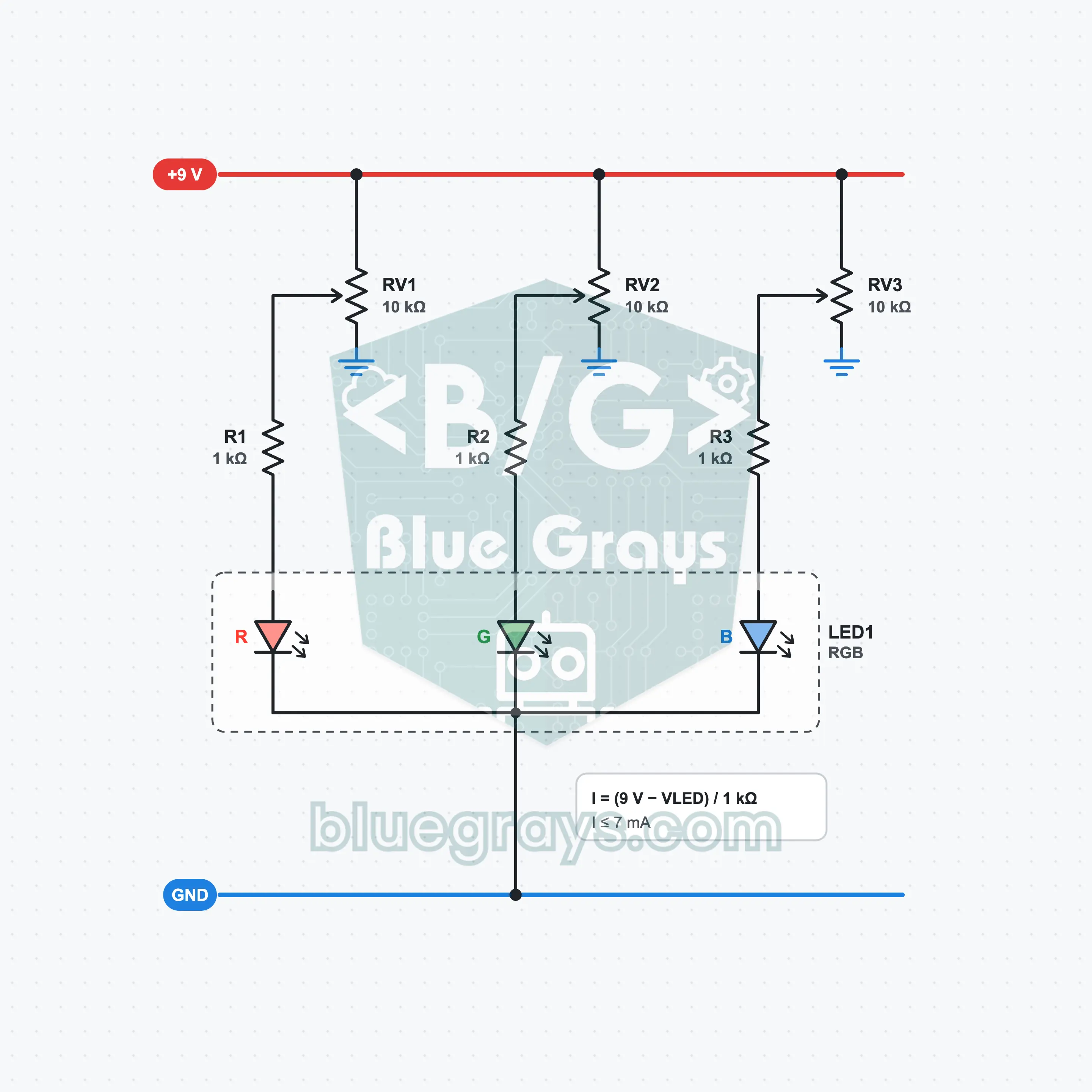
It is built with a 9 V battery, one common cathode RGB LED, three 10 kΩ potentiometers, three 1 kΩ resistors and ten jumper wires. Each pot works as a voltage divider between 9 V and GND; the voltage on its middle leg drives one color of the LED through a 1 kΩ resistor. Red draws 7 mA at most, green and blue 6 mA. What you learn: the legs of an RGB LED, the common cathode connection, how colors of light mix by adding up and using a potentiometer with all three legs.
Premium Content
This circuit's build steps, how-it-works guide and FAQ are open to Premium members.
- Build Steps
- How It Works
- Frequently Asked Questions