
EL-18IntermediatePremiumTransistor circuits
Driving a Relay: Relay Control with a Transistor and Diode
A relay is a mechanical switch that turns a completely separate circuit on and off with a small current. In this circuit, when you press the button the BC547 feeds current to the relay's coil, the contact closes with a click and the LED lights. The 1N4007 diode connected in reverse across the coil protects the transistor from the voltage spike that appears at turn-off. Here the contact only switches an LED at 5 V: never try mains voltage on a breadboard.
5.0(1)
1 completed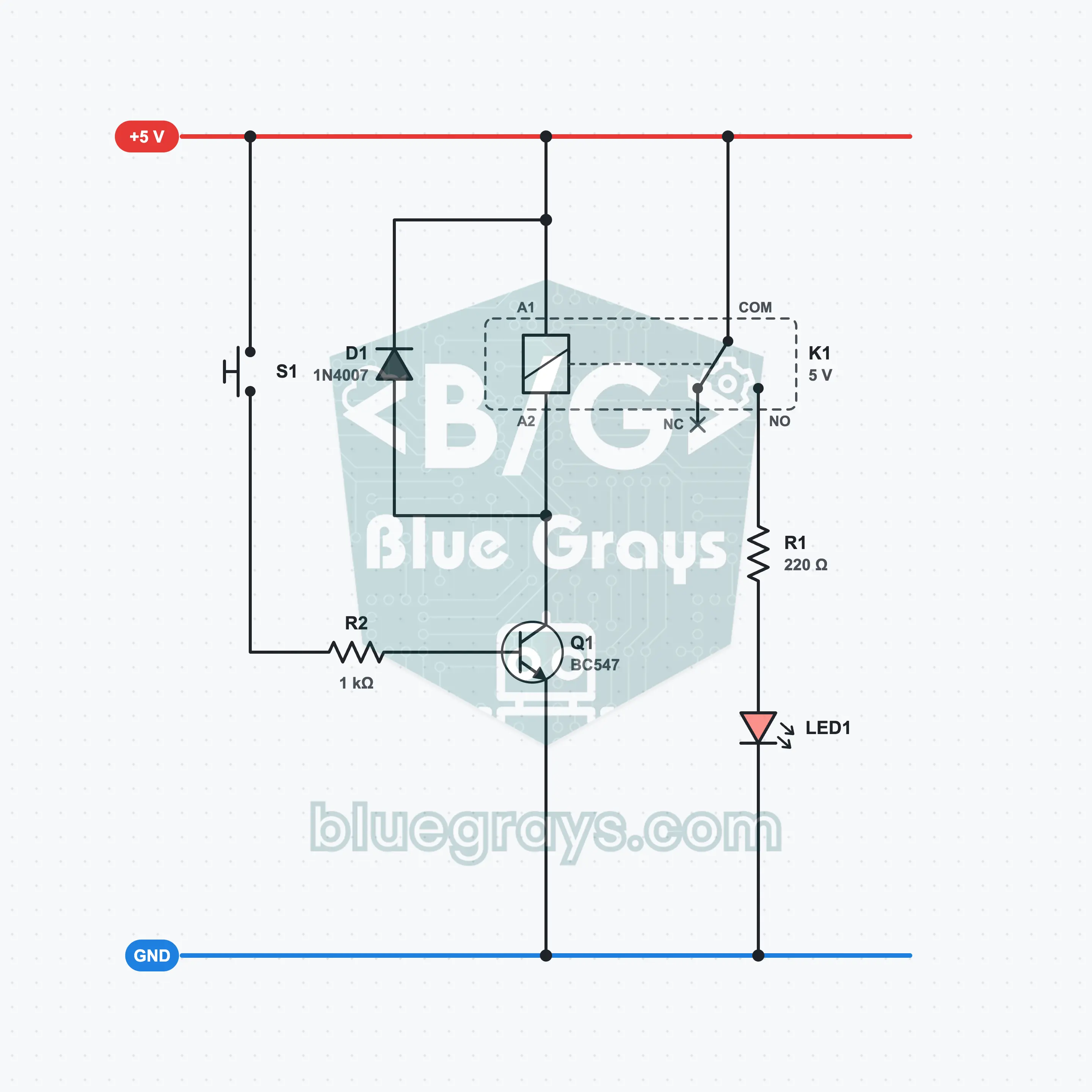
It is built with a 5 V supply, a 5 V single-pole relay, one BC547, one 1N4007 diode, 1 kΩ and 220 Ω resistors, one button and one red LED. Because the relay does not fit a breadboard, it is connected with four female-to-male jumper wires. The button supplies a base current of 4.3 mA, and the transistor switches the coil's current of about 69 mA. The cathode of the diode is at +5 V and its anode is at the collector. What you learn: coil and contact, the NO and NC terminals, the flyback diode, base resistor calculation. The contact is used at low voltage only.
Premium Content
This circuit's build steps, how-it-works guide and FAQ are open to Premium members.
- Build Steps
- How It Works
- Frequently Asked Questions