
EL-15BeginnerPremiumTransistor circuits
Water Level Alarm: Two-Transistor Water Detector
An alarm that sounds when the water rises. When two bare wire ends touch water, the water passes a very weak current between them. This current cannot run a buzzer by itself; two BC547s connected as a Darlington pair amplify it thousands of times and the active buzzer sounds. This is the basis of circuits that warn you before the bathtub overflows or a plant saucer fills up. You try out the conductivity of water and how the gains of two transistors multiply.
0.0(0)
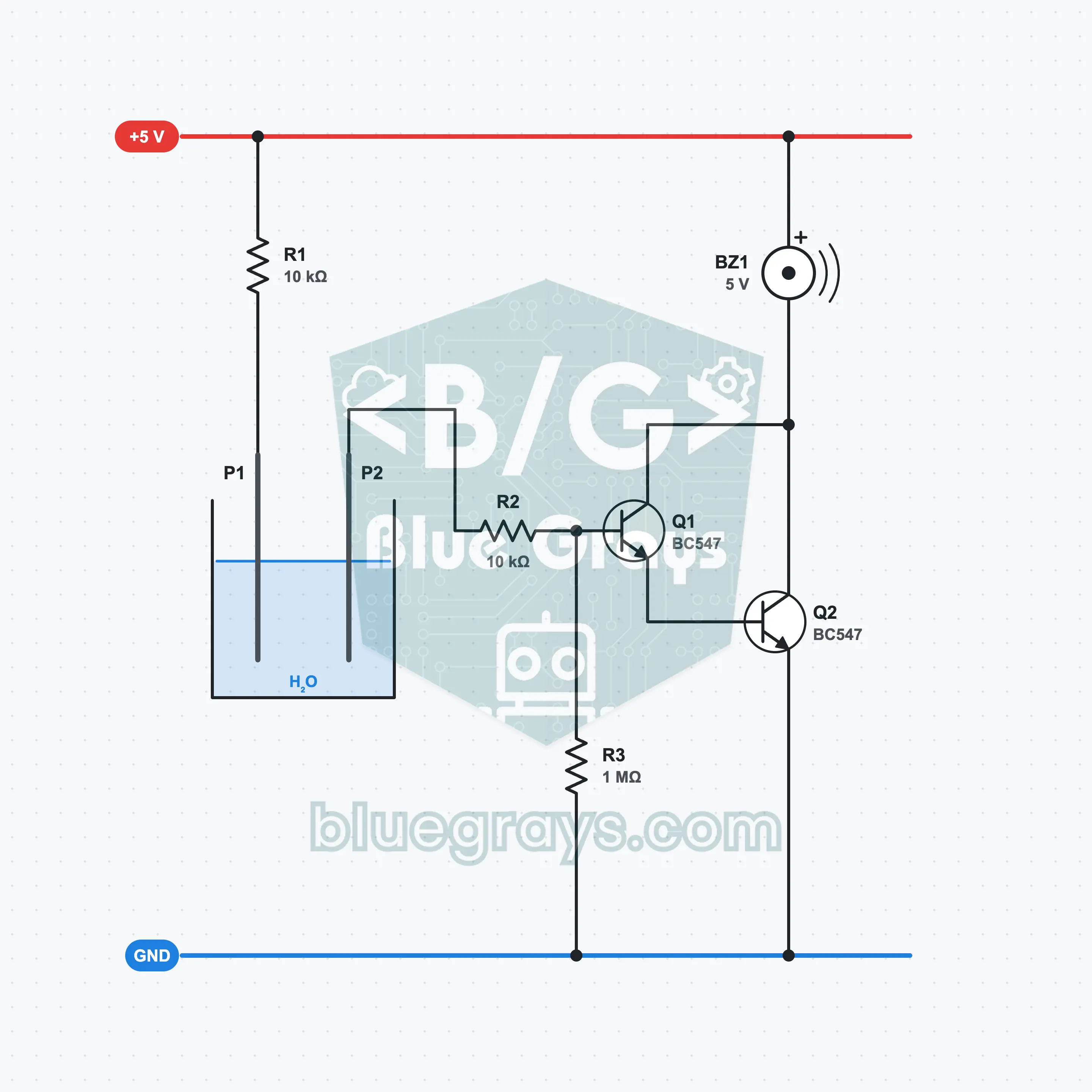
It is built with a 5 V supply, two BC547s, two 10 kΩ resistors and one 1 MΩ resistor, an active buzzer and two jumper wires as probes. One probe goes to +5 V through 10 kΩ, the other to the base of the first transistor through 10 kΩ. When water joins the two probes, a base current of about 30 µA flows; the Darlington pair amplifies it at least 12,000 times and the buzzer sounds. The 1 MΩ resistor holds the base at GND while the probes are in the air. What you learn: the conductivity of water, the Darlington connection, gain calculation, protective and pull-down resistors.
Premium Content
This circuit's build steps, how-it-works guide and FAQ are open to Premium members.
- Build Steps
- How It Works
- Frequently Asked Questions