
EL-101IntermediatePremiumTransistor circuits
Lie Detector: A Party Game That Measures Skin Resistance
A party game that puts the green LED out and lights the red one when your fingers sweat. Foils on two fingers of one hand measure skin resistance; excitement means sweat, so the resistance drops. Three BC547s amplify this tiny current, and the RV1 pot sets the threshold to your own calm value. It is not a real lie detector: it shows excitement and moisture, not lies. Results vary a lot. You explore skin conductivity, the voltage divider and a Darlington pair.
0.0(0)
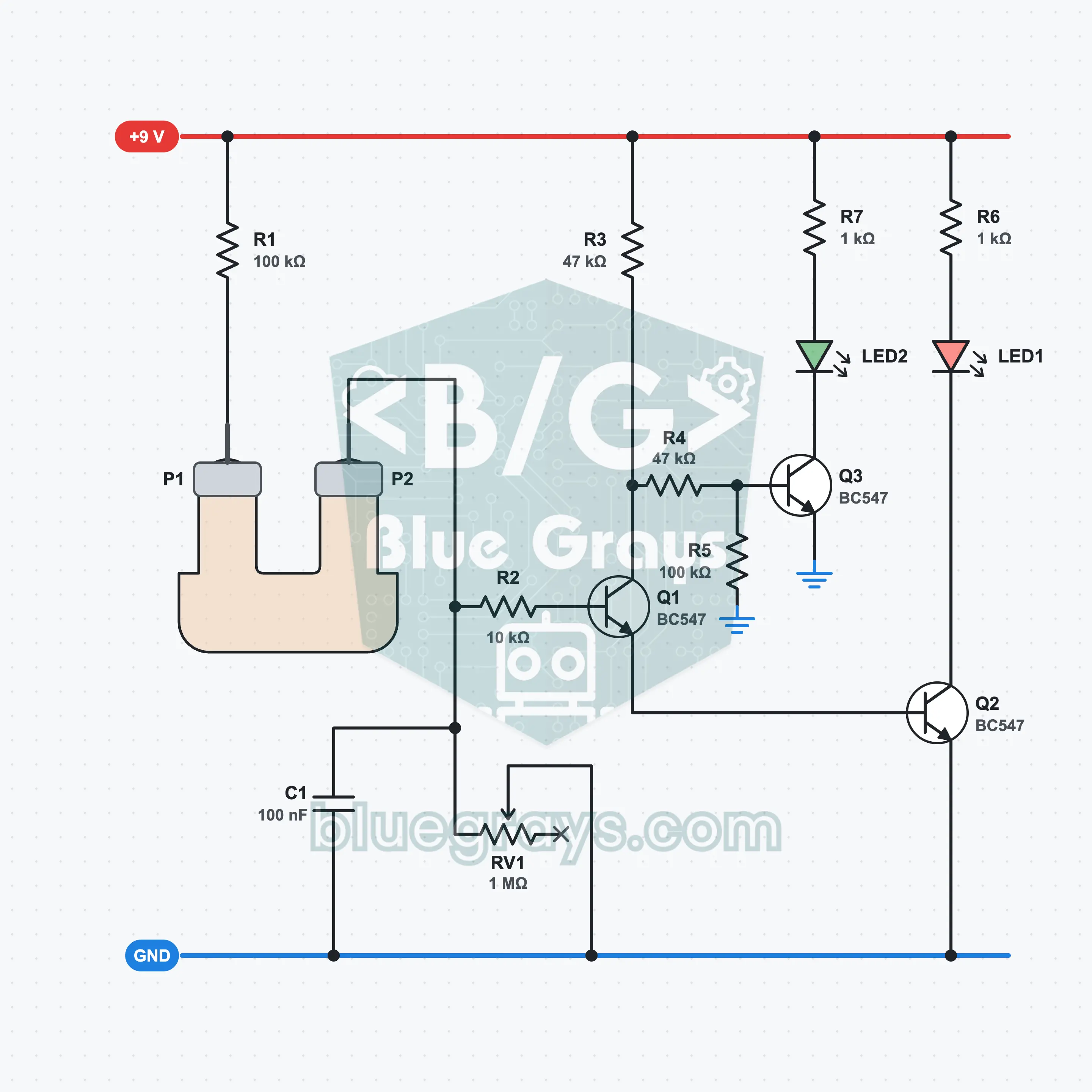
It is built with a 9 V battery, three BC547s, one green and one red LED, seven resistors, a 1 MΩ pot, a 100 nF capacitor and two jumper wires with aluminum foil wrapped around their ends. The skin resistance forms a voltage divider between R1 and RV1. When you are calm the green LED is on; when your fingers sweat and the resistance drops by 10 to 20 percent, the red LED lights. Only a few µA pass through your finger. This is a game, it does not measure lies: even a real polygraph is not accepted as proof, and the result varies a lot depending on whether your hands are dry or damp.
Premium Content
This circuit's build steps, how-it-works guide and FAQ are open to Premium members.
- Build Steps
- How It Works
- Frequently Asked Questions