
EL-14BeginnerPremiumTransistor circuits
Broken-Beam Alarm: A Light Barrier with an LDR and Buzzer
An alarm that sounds when light is blocked. While the LDR receives light, it stays silent; when a hand or object blocks the light, the active buzzer sounds and the LED lights. The LDR and a resistor form a voltage divider; two BC547s in a Darlington pair drive the buzzer. You set the triggering shadow level with the potentiometer. No laser needed: room light or a phone flashlight is enough. Try the principle of doorway light barriers on your desk.
0.0(0)
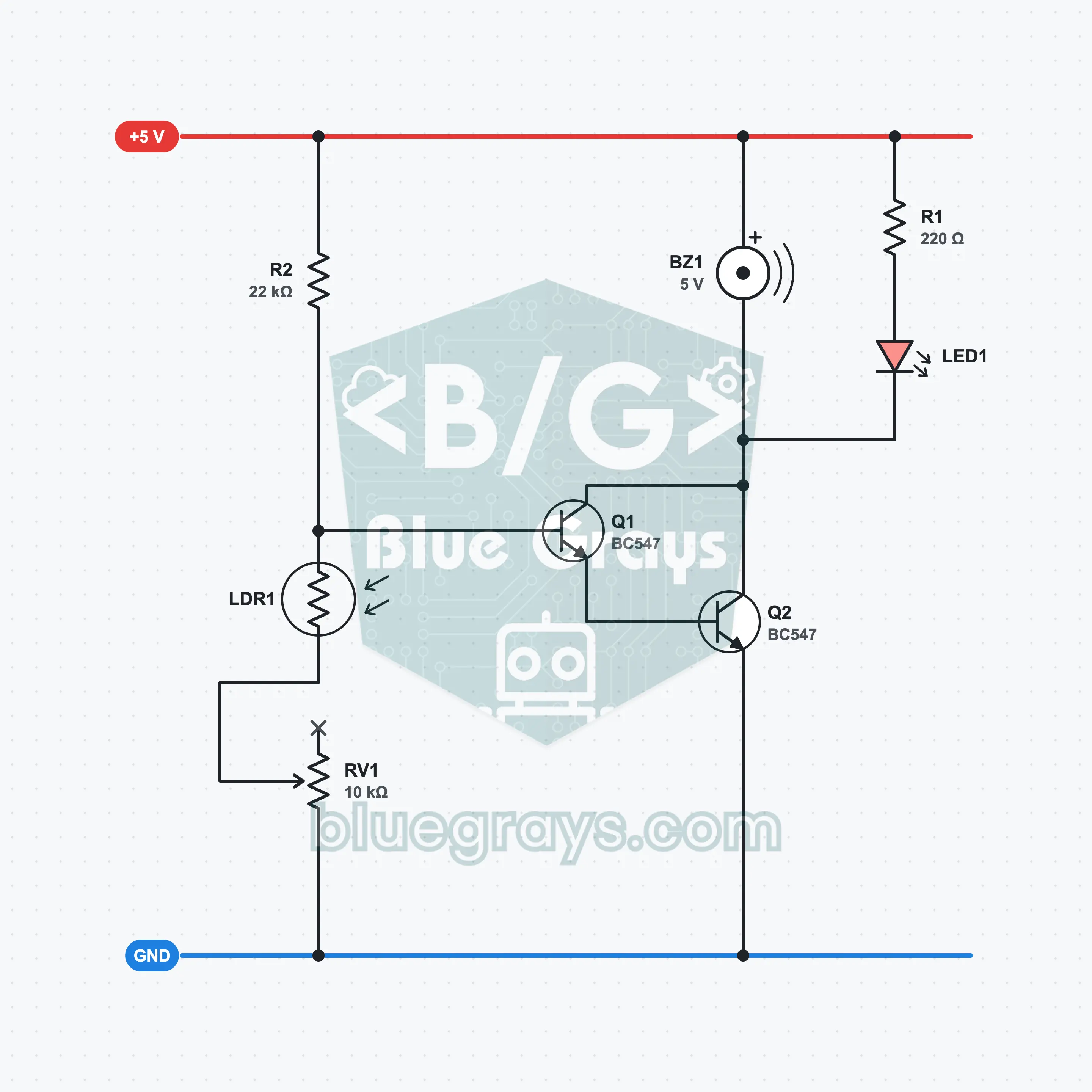
It is built with a 5 V supply, two BC547s, an LDR, a 10 kΩ potentiometer, 22 kΩ and 220 Ω resistors, an active buzzer and a red LED. The 22 kΩ resistor is in the upper branch of the divider, and the LDR and potentiometer are in the lower branch; the base of the first transistor is connected to the midpoint. In the light, the base stays below 1 V and the circuit is silent. When the light is blocked, the base voltage rises and the Darlington pair turns on; the buzzer sounds and the LED lights. What you learn: light barriers, setting a threshold with a voltage divider, the Darlington connection and driving a load with a transistor.
Premium Content
This circuit's build steps, how-it-works guide and FAQ are open to Premium members.
- Build Steps
- How It Works
- Frequently Asked Questions