
EL-16BeginnerPremiumTransistor circuits
Thirsty Plant Indicator: An LED That Lights When the Soil Dries Out
A soil moisture indicator that lights an LED when the soil in the pot dries out, telling you it is time to water. Two nails are pushed into the soil: wet soil passes current easily, dry soil barely does. A two-stage switch built with two BC547s inverts the signal; while the soil is wet the LED stays off, and when it dries out the LED lights. You set the threshold for your own soil with the RV1 pot. You try out the conductivity of soil, inverting with a transistor and electrolysis.
0.0(0)
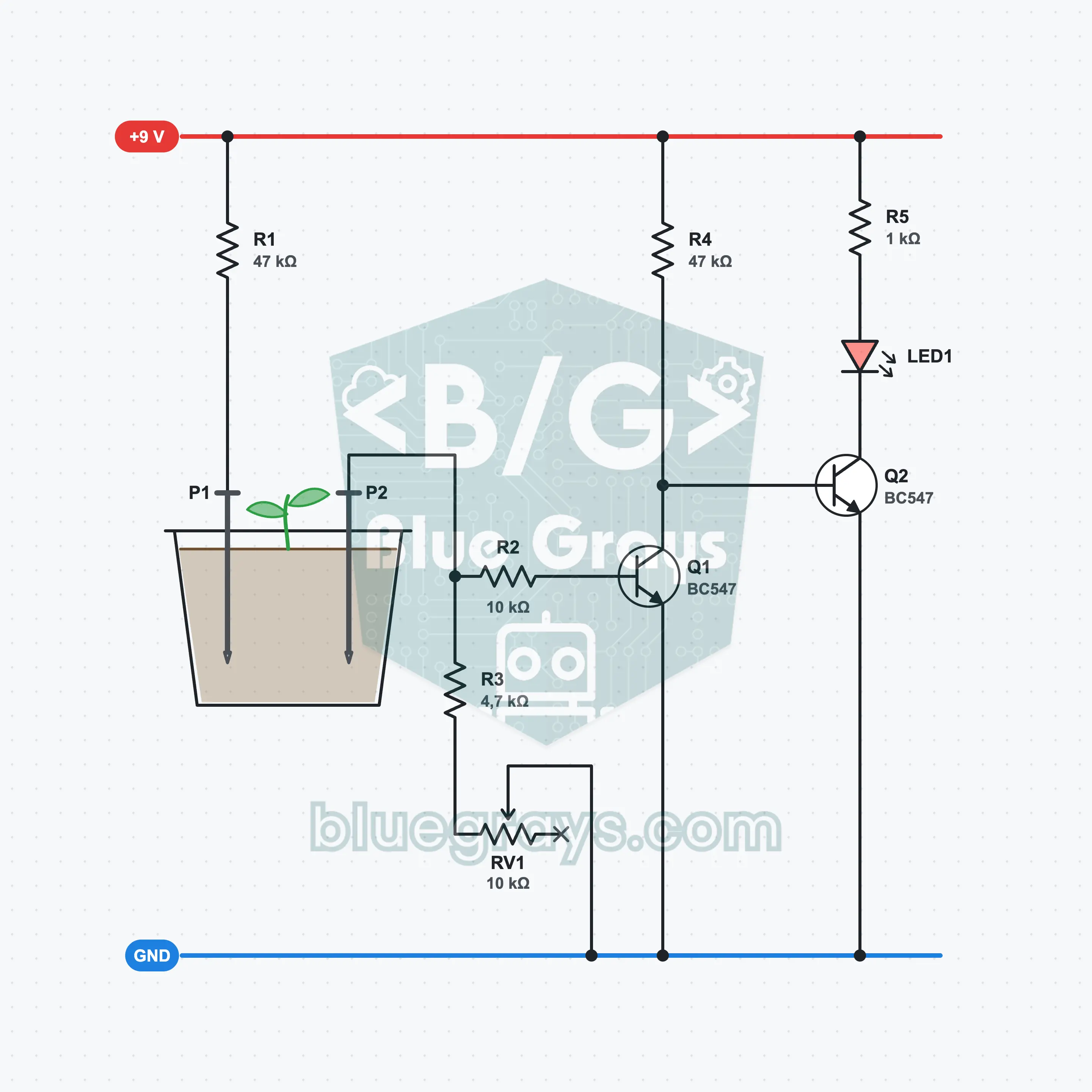
It is built with a 9 V battery, two BC547s, one LED, five resistors, a 10 kΩ pot and two jumper wires with a nail taped to the end of each. The resistance of the soil forms a voltage divider between R1 on one side and R3 and RV1 on the other. In wet soil Q1 turns on and turns Q2 off; when the soil dries out and its resistance goes above the threshold, Q1 turns off and Q2 lights the LED with about 7 mA. The threshold is set with RV1 between about 19 kΩ and 159 kΩ. What you learn: the conductivity of soil, the voltage divider, inverting with two transistor stages, the threshold calculation and why direct current makes the nails rust.
Premium Content
This circuit's build steps, how-it-works guide and FAQ are open to Premium members.
- Build Steps
- How It Works
- Frequently Asked Questions